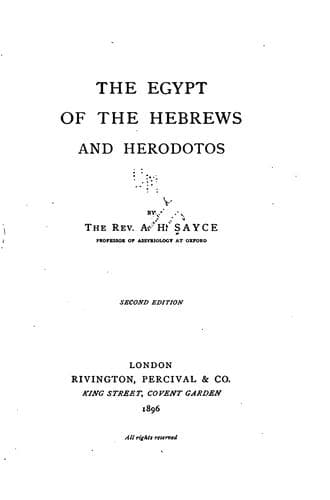
The Egypt of the Hebrews and HerodotosSayce, A. H. (Archibald Henry)
History
The Egypt of the Hebrews and Herodotos
Sayce, A. H. (Archibald Henry)
Egypt -- History, Ancient
All attempts to oust it proved unavailing, and the approach of a great
Persian army under Megabyzos obliged the Greeks to retreat to the island
of Prosopites. Here they were blockaded for a year and a half; then the
besiegers turned the river aside and marched over its dry bed against the
camp of the allies, which they took by storm. The Greek expedition was
annihilated, and Inarôs fell into the hands of his enemies, who sent him
to Persia and there impaled him. Amyrtæos, however, still maintained
himself in the marshes of the Delta, and in B.C. 449 Kimon sent sixty
ships of the Athenian fleet to assist him in the struggle. But before they
could reach the coast of Egypt news arrived of the death of Kimon, and the
ships returned home. Four years later, if we may trust Philokhorus,
another Egyptian prince, Psammetikhos, who seems to have succeeded
Amyrtæos, sent 72,000 bushels of wheat to Athens in the hope of buying
therewith Athenian help. But it does not appear to have been given, and
Egypt once more sullenly obeyed the Persian rule. We learn from Herodotos
(iii. 15) that “the great king” even allowed Thannyras and Pausiris, the
sons of his inveterate enemies Inarôs and Amyrtæos, to succeed to the
principalities of their fathers.
Paprêmis was visited by Herodotos, and he saw there the sham fight between
the priests at the door of the temple on the occasion of their chief
festival. He also went to the site of the battle-field, and there beheld
“a great marvel.” The skeletons of the combatants lay on separate sides of
the field just as they had fallen, and whereas the skulls of the Persians
were so thin that they could be shattered by a pebble, those of the
Egyptians were thick and strong enough to resist being battered with a
stone. The cause of this difference was explained to him by the dragoman:
the Egyptians shaved their heads from childhood and so hardened the bones
of it against the sun, while the Persians shaded their heads by constantly
wearing caps of thick felt.
Not many years could have elapsed since the battle had occurred. The visit
of the Greek traveller to the scene of it may therefore be laid between
B.C. 455 and 450. The patriots of Egypt must have been still struggling
for their liberty among the marshes of the northern Delta.
Public-domain text, read in full here on John Shaqi.
Reviews
Reviews
No reviews yet
Be the first to share your thoughts on this work.
Elsewhere in the archive
Join the Discussion
Join the discussion
Sign in to leave a comment or review.
Sign InorCreate an account