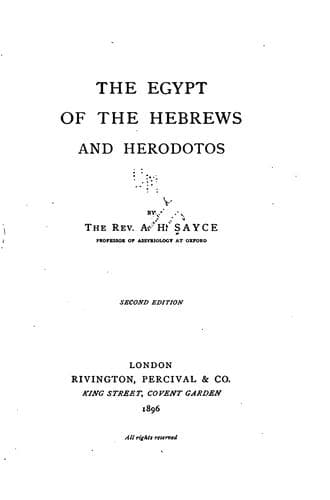
The Egypt of the Hebrews and HerodotosSayce, A. H. (Archibald Henry)
History
The Egypt of the Hebrews and Herodotos
Sayce, A. H. (Archibald Henry)
Egypt -- History, Ancient
time, and if his plagiarisms exceeded theirs it was only because he had
read more and made a more diligent use of his note-book.
It is we, and not the Greek world for which he wrote, who are the
sufferers. It is frequently difficult, if not impossible, for us to tell
whether Herodotos is speaking from his own experience or quoting from
others, whose trustworthiness is doubtful or whose statements may have
been misunderstood. From time to time internal evidence assures us that we
are dealing, not with Herodotos himself, but with some other writer whose
remarks he has embodied. His commentators have continually argued on the
supposition that, wherever the first person is used, it is Herodotos
himself who is speaking. Statements of his accordingly have been declared
to be true, in spite of the contrary evidence of oriental research,
because, it is urged, he is a trustworthy witness and has reported
honestly what he heard and saw. But if he did not hear and see the
supposed facts, the case is altered and the argument falls to the ground.
Herodotos took part in the foundation of the colony of Thurii in southern
Italy in B.C. 445, and there, rather than at the Olympic festival, as
later legend believed, he read to the assembled Greeks the whole or a part
of his history. His travels in Egypt, therefore, must have already taken
place. Their approximate date, indeed, is fixed by what he tells us about
the battlefield of Paprêmis (iii. 12).
At Paprêmis, for the first time, an Egyptian army defeated the Persian
forces. Its leader was Inarôs the Libyan, and doubtless a large body of
Libyans was enrolled in it. Along with Amyrtæos he had led the Egyptians
to revolt in the fifth year of the reign of Artaxerxes I. (B.C. 460).
Akhæmenes, the satrap of Egypt, was routed and slain, and for six years
Egypt maintained a precarious freedom. The fortresses at Memphis and
Pelusium, however, remained in the hands of the Persians, and in spite of
all the efforts of the Egyptians, they could not be dislodged. Greek aid
accordingly was sought, and the Athenians, still at war with Persia, sent
two hundred ships from Cyprus to the help of the insurgents. The ships
sailed up the Nile as far as Memphis, where the Persian garrison still
held out.
Public-domain text, read in full here on John Shaqi.
Reviews
Reviews
No reviews yet
Be the first to share your thoughts on this work.
Elsewhere in the archive
Join the Discussion
Join the discussion
Sign in to leave a comment or review.
Sign InorCreate an account