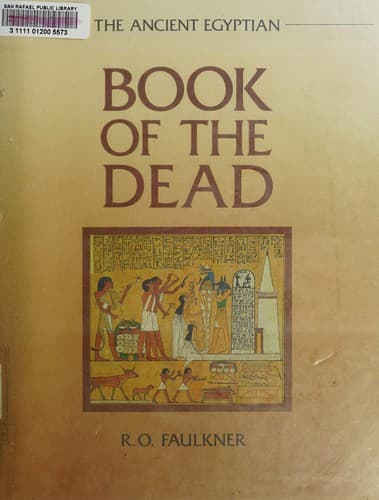
Before speaking of its contents, we have to state briefly under what
form the book has come down to us. It is hardly necessary to repeat that
it is no book at all in the ordinary sense of the word. It is neither a
unity nor a whole, it is a collection which has grown by degrees, at
various epochs. Undoubtedly part of it goes back as far as the Old
Empire; the texts of the Middle Empire show already that there were
various editions, and we are forced to admit that its origin is not much
later than the beginning of Egyptian civilization, as we see that some
of the rubrics attribute certain chapters to a king of the 1st dynasty.
In the course of centuries the original text was modified and enlarged,
new chapters were added, revisions were made, without casting these
detached fragments into a whole. The various parts of the book were
always independent, like the Hebrew Psalms; the acceptance of a chapter
does not necessarily imply the acceptance of the next chapter, and it
seems as if the relatives of the deceased chose in the collection which
was at their disposal what they liked best, and the number of chapters
which corresponded to the price they wished to pay for a papyrus.
This description applies chiefly to the texts of the Book of the Dead of
the period prior to the XXVIth dynasty. Under the Saïte kings it seems
that a complete revision of the text was made; a definite order was
adopted, which was not rigidly binding on the writers, but to which they
generally adhered; various chapters were added, especially the last
ones, 162-165, which are never found in the older copies. It seems also
that something like what we should call an authorized version was
adopted; and this was done by men to whom the book was hardly
intelligible. A great many glosses were introduced, which were copied
afterwards in all the hieroglyphic and hieratic texts. Although we do
not find the strict accuracy of Hebrew manuscripts, the number of
variants in the Saïte, Ptolemaïc or Roman texts is considerably smaller
than in the manuscripts of the Theban period, and a collation of the
hundreds of papyri of late epoch which fill our museums would lead to no
great result.
However, it is from a text generally considered as Saïtic, but which I
believe to be of the Ptolemaïc epoch, that the Book of the Dead has been
first made known in all its extent. In 1842 Lepsius published the long
papyrus in the Turin Museum, a document which he called “the largest
piece of Egyptian literature which has been preserved.”
Public-domain text, read in full here on John Shaqi.
Reviews
Reviews
No reviews yet
Be the first to share your thoughts on this work.
Join the Discussion
Join the discussion
Sign in to leave a comment or review.
Sign InorCreate an account