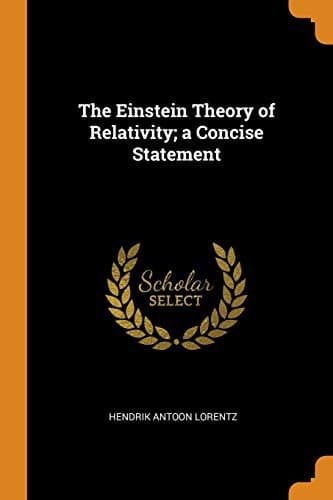
The Einstein Theory of Relativity: A Concise StatementLorentz, H. A. (Hendrik Antoon)
Science
The Einstein Theory of Relativity: A Concise Statement
Lorentz, H. A. (Hendrik Antoon)
Einstein, Albert, 1879-1955; Relativity (Physics)
During a discussion of the results obtained at a joint meeting of
the Royal Society and the Royal Astronomical Society held especially
for that purpose recently in London, it was the general opinion that
Einstein's prediction might be regarded as justified, and warm tributes
to his genius were made on all sides. Nevertheless, I cannot refrain,
while I am mentioning it, from expressing my surprise that, according
to the report in The Times there should be so much complaint about
the difficulty of understanding the new theory. It is evident that
Einstein's little book "About the Special and the General Theory of
Relativity in Plain Terms," did not find its way into England during
wartime. Any one reading it will, in my opinion, come to the conclusion
that the basic ideas of the theory are really clear and simple; it is
only to be regretted that it was impossible to avoid clothing them in
pretty involved mathematical terms, but we must not worry about that.
I allow myself to add that, as we follow Einstein, we may retain
much of what has been formerly gained. The Newtonian theory remains
in its full value as the first great step, without which one cannot
imagine the development of astronomy and without which the second
step, that has now been made, would hardly have been possible. It
remains, moreover, as the first, and in most cases, sufficient,
approximation. It is true that, according to Einstein's theory,
because it leaves us entirely free as to the way in which we wish to
represent the phenomena, we can imagine an idea of the solar system
in which the planets follow paths of peculiar form and the rays of
light shine along sharply bent lines--think of a twisted and distorted
planetarium--but in every case where we apply it to concrete questions
we shall so arrange it that the planets describe almost exact ellipses
and the rays of light almost straight lines.
It is not necessary to give up entirely even the ether. Many natural
philosophers find satisfaction in the idea of a material intermediate
substance in which the vibrations of light take place, and they
will very probably be all the more inclined to imagine such a medium
when they learn that, according to the Einstein theory, gravitation
itself does not spread instantaneously, but with a velocity that at
the first estimate may be compared with that of light. Especially in
former years were such interpretations current and repeated attempts
were made by speculations about the nature of the ether and about
the mutations and movements that might take place in it to arrive
at a clear presentation of electro-magnetic phenomena, and also of
the functioning of gravitation. In my opinion it is not impossible
that in the future this road, indeed abandoned at present, will once
more be followed with good results, if only because it can lead to the
thinking out of new experimental tests. Einstein's theory need not keep
us from so doing; only the ideas about the ether must accord with it.
Public-domain text, read in full here on John Shaqi.
Reviews
Reviews
No reviews yet
Be the first to share your thoughts on this work.
Join the Discussion
Join the discussion
Sign in to leave a comment or review.
Sign InorCreate an account