The Electoral Votes of 1876: Who Should Count Them, What Should Be Counted, and the Remedy for a Wrong Count — John Shaqi
The Electoral Votes of 1876: Who Should Count Them, What Should Be Counted, and the Remedy for a Wrong CountField, David Dudley
History
The Electoral Votes of 1876: Who Should Count Them, What Should Be Counted, and the Remedy for a Wrong Count
Field, David Dudley
Presidents -- United States -- Election -- 1876
E-text prepared by Meredith Bach, Richard J. Shiffer, and the Project
Gutenberg Online Distributed Proofreading Team (http://www.pgdp.net) from
digital material generously made available by Internet Archive/American
Libraries (http://www.archive.org/details/americana)
Note: Images of the original pages are available through
Internet Archive/American Libraries. See
http://www.archive.org/details/electoralvote187600fielrich
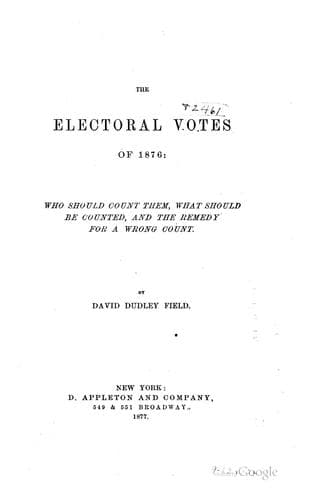
THE ELECTORAL VOTES OF 1876:
Who Should Count Them, What Should
Be Counted, and the Remedy
for a Wrong Count.
by
DAVID DUDLEY FIELD.
New York:
D. Appleton and Company,
549 & 551 Broadway.
1877.
Copyright by D. Appleton and Company, 1877.
THE ELECTORAL VOTES OF 1876.
WHO SHOULD COUNT THEM,
WHAT SHOULD BE COUNTED, AND
THE REMEDY FOR A WRONG COUNT.
The electoral votes of 1876 have been cast. The certificates are now
in Washington, or on their way thither, to be kept by the President of
the Senate until their seals are broken in February. The certificates
and the votes of thirty-four of the States are undisputed. The
remaining four are debatable, and questions respecting them have
arisen, upon the decision of which depends the election of the
incoming President. These questions are: Who are to count the votes;
what votes are to be counted; and what is the remedy for a wrong
count? I hope not to be charged with presumption if, in fulfilling my
duty as a citizen, I do what I can toward the answering of these
questions aright; and, though I happen to contribute nothing toward
satisfactory answers, I shall be excused for making the effort.
The questions themselves have no relation to the relative merits of
the two candidates. Like other voters, I expressed my own preference
on the morning of the election. That duty is discharged; another duty
supervenes, which is, to take care that my vote is counted and allowed
its due place in the summary of the votes. Otherwise the voting
performance becomes ridiculous, and the voter deserves to be laughed
at for his pains. His duty--to cast his vote according to his
conscience--was clear; it is no less his duty to make the vote felt,
along with other like votes, according to the laws.
The whole duty of a citizen is not ended when his vote is delivered;
there remains the obligation to watch it until it is duly weighed, in
adjusting the preponderance of the general choice. Whatever may be the
ultimate result of the count, whether his candidate will have lost or
won, is of no importance compared with the maintenance of justice and
the supremacy of law over the preferences and passions of men.
Public-domain text, read in full here on John Shaqi.
Reviews
Reviews
No reviews yet
Be the first to share your thoughts on this work.
Join the Discussion
Join the discussion
Sign in to leave a comment or review.
Sign InorCreate an account