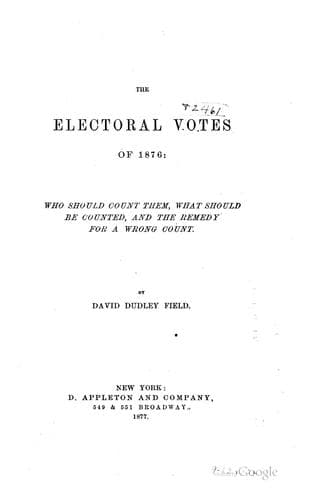
The Electoral Votes of 1876: Who Should Count Them, What Should Be Counted, and the Remedy for a Wrong Count — John Shaqi
The Electoral Votes of 1876: Who Should Count Them, What Should Be Counted, and the Remedy for a Wrong CountField, David Dudley
History
The Electoral Votes of 1876: Who Should Count Them, What Should Be Counted, and the Remedy for a Wrong Count
Field, David Dudley
Presidents -- United States -- Election -- 1876
is the remaining question. Hitherto, I have endeavored to state in a
popular manner the existing law, as I understand it. I will now ask a
consideration of the needs of future legislation. If there be anything
obscure in the present law, Congress has the power to make it clear;
if there be danger in our present condition, Congress can remove the
danger. There are various ways of doing it.
One is to provide for a judicial committee of the two Houses, to sit
in judgment, as if they were judges, and pronounce upon the result of
the evidence. The English House of Commons used to reject or admit
members, from considerations of party. Englishmen have thought that
they had at last succeeded in establishing a tribunal which would
decide with impartiality and justice. We should be able to devise
means equally sure of arriving at a result just in itself, and
satisfactory to all. The considerations in favor of a judicial
committee of the two Houses are cogent, though they may not be
conclusive. They are, the necessity of a speedy decision, and the
desirableness of keeping, if possible, the ordinary courts out of
contact with questions of the greatest political significance.
But if it be found impossible to agree upon the formation of such a
committee, then a resort to the courts should certainly be had. The
public conscience must be satisfied that the person sitting in our
highest seat of magistracy is there by a just title; and it can be
satisfied of that, in doubtful cases, only by a judicial inquiry.
An act of Congress might provide either for the case of a double
declaration of the votes, one by each House of Congress, or of a
single declaration by the two Houses acting in concert. In either case
the Supreme Court could be reached only by appeal, and the court of
first instance might be either the Supreme Court of the District of
Columbia or any of the Circuit Courts. The Court of the District
should seem to be the most convenient, the most speedy, and the most
appropriate, as being at the seat of Government.
Public-domain text, read in full here on John Shaqi.
Reviews
Reviews
No reviews yet
Be the first to share your thoughts on this work.
Join the Discussion
Join the discussion
Sign in to leave a comment or review.
Sign InorCreate an account