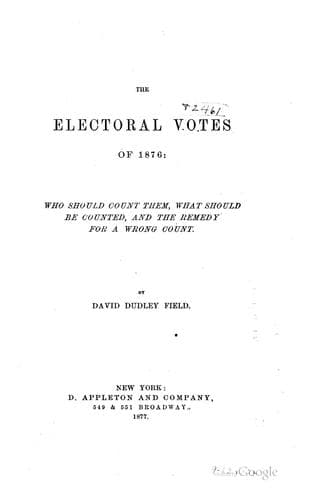
The Electoral Votes of 1876: Who Should Count Them, What Should Be Counted, and the Remedy for a Wrong CountField, David Dudley
History
The Electoral Votes of 1876: Who Should Count Them, What Should Be Counted, and the Remedy for a Wrong Count
Field, David Dudley
Presidents -- United States -- Election -- 1876
"Before proceeding to state our views in regard to the law
regulating the canvass of votes by the State canvassers, we
propose to consider how far the right of a person to an office is
affected by the determination of the canvassers of the votes cast
at the election held to choose the officer. Under our
constitution, almost all our officers are elected by the people.
Thus the Governor is chosen, the constitution providing that the
person having the highest number of votes for that office shall
be elected. But the constitution is silent as to the mode in
which the election shall be conducted, and the votes cast for
Governor shall be canvassed and the result of the election
ascertained. The duty of prescribing the mode of conducting the
election, and of canvassing the votes was, therefore, devolved
upon the Legislature. They have accordingly made provision for
both, and the question is, whether the canvass, or the election,
establishes the right of a person to an office. It seems clear
that it cannot be the former, because by our constitution and
laws it is expressly provided that the election by the qualified
voters shall determine the question. To hold that the canvass
shall control, would subvert the foundations upon which our
government rests. But it has been repeatedly contended in the
course of this proceeding that, although the election by the
electors determines the right to the office, yet the decision of
the persons appointed to canvass the votes cast at the election,
settles finally and completely the question as to the persons
elected, and that, therefore, no court can have jurisdiction to
inquire into the matter. It will be seen that this view of the
question, while it recognizes the principle that the election is
the foundation of the right to the office, assumes that the
canvassers have authority to decide the matter finally and
conclusively. We do not deem it necessary to say anything on the
present occasion upon the subject of the jurisdiction of this
court, as that question has already been decided, and the reasons
for the decision given. Bearing it in mind, then, that under our
constitution and laws, it is the election to an office, and not
the canvass of the votes, which determines the right to the
office, we will proceed to inquire into the proceedings of the
State canvassers, by which they determined that the respondent
was duly elected."--(4 _Wis._, 792.)
APPLETONS' PERIODICALS.
APPLETONS' JOURNAL:
A MONTHLY MISCELLANY OF POPULAR LITERATURE.
NEW SERIES.
_TWENTY-FIVE CENTS PER NUMBER. THREE DOLLARS PER ANNUM._
Public-domain text, read in full here on John Shaqi.
Reviews
Reviews
No reviews yet
Be the first to share your thoughts on this work.
Join the Discussion
Join the discussion
Sign in to leave a comment or review.
Sign InorCreate an account