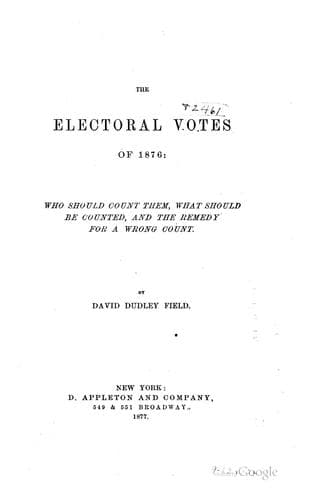
The Electoral Votes of 1876: Who Should Count Them, What Should Be Counted, and the Remedy for a Wrong CountField, David Dudley
History
The Electoral Votes of 1876: Who Should Count Them, What Should Be Counted, and the Remedy for a Wrong Count
Field, David Dudley
Presidents -- United States -- Election -- 1876
The action of the present Houses, moreover, is an affirmance of their
right to eliminate the false votes from the true. Else why these
committees of each House, investigating at Washington and in the North
and South? Are all the labor and expense of these examinations
undertaken solely in order that the results may be laid before the
President of the Senate for _his_ supreme judgment in the premises? It
is safe to say that there is not a single member of either House who
would not laugh you in the face for asking seriously the question.
Assuming, then, that the power to decide what votes shall be counted
belongs to the two Houses, how must they exercise it? Here, again, let
me take the illustration with which I began, of the coins upon a
banker's counter. Let us suppose that, instead of one clerk, two were
told to count them together. When they came to a particular coin upon
which they disagreed, one insisting that it was genuine and the other
that it was counterfeit, what would then happen, if they did their
duty? They would count the rest and lay that aside, reporting the
disagreement to their superior. The two Houses of Congress have,
however, no superior, except the States and the people. To these there
can be no reference on the instant; and the action of the two Houses
must be final for the occasion.
There can be no decision of the Houses if they disagree, and, as no
other authority can decide, there can be no decision at all. The
counting, including the selection, is an affirmative act; and as two
are to perform it, if performed at all, no count or selection can be
made when the two do not concur. Two judges on the bench cannot render
a judgment when there is a disagreement between them. No more can the
two Houses of Congress. There is here no pretense of alternative
power, playing back and forth between the President of the Senate and
the two Houses. If the former has not power complete and exclusive, he
has none. The result must be that, what the two Houses do not agree to
count, cannot be counted.
WHAT VOTES SHOULD BE COUNTED.
This is the second question. The votes to be counted are the votes of
the electors. But who are the electors? The persons appointed by the
States, in the manner directed by their Legislatures respectively. How
is the fact of appointment to be proved? These are the subordinate
questions, the answers to which go to make up the answer to the main
question.
What are the means of separating the genuine from the counterfeit?
Where are the tests by which to distinguish the true votes from the
false?
Public-domain text, read in full here on John Shaqi.
Reviews
Reviews
No reviews yet
Be the first to share your thoughts on this work.
Join the Discussion
Join the discussion
Sign in to leave a comment or review.
Sign InorCreate an account