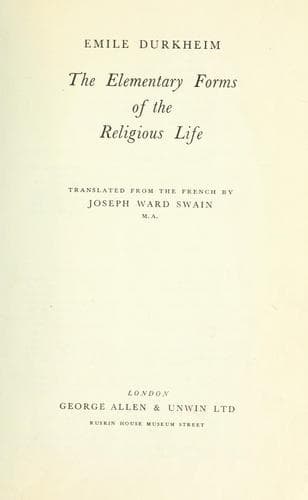
The Elementary Forms of the Religious LifeDurkheim, Émile
Religion
The Elementary Forms of the Religious Life
Durkheim, Émile
Cults; Religion; Religion -- Philosophy; Rites and ceremonies; Totemism
In order to give a semblance of intelligibility to this duality, so
strange for us, the primitive has invented myths which, it is true,
explain nothing and only shift the difficulty, but which, by shifting
it, seem at least to lessen the logical scandal. With slight variations
of detail, all are constructed on the same plan: their object is to
establish genealogical connections between the man and the totemic
animal, making the one a relative of the other. By this common origin,
which, by the way, is represented in various manners, they believe that
they account for their common nature. The Narrinyeri, for example, have
imagined that certain of the first men had the power of transforming
themselves into beasts.[390] Other Australian societies place at the
beginning of humanity either strange animals from which the men were
descended in some unknown way,[391] or mixed beings, half-way between
the two kingdoms,[392] or else unformed creatures, hardly representable,
deprived of all determined organs, and even of all definite members, and
the different parts of whose bodies were hardly outlined.[393] Mythical
powers, sometimes conceived under the form of animals, then intervened
and made men out of these ambiguous and innumerable beings which Spencer
and Gillen say represent "stages in the transformation of animals and
plants into human beings."[394] These transformations are represented to
us under the form of violent and, as it were, surgical operations. It is
under the blows of an axe or, if the operator is a bird, blows of the
beak, that the human individual was carved out of this shapeless mass,
his members separated from each other, his mouth opened and his nostrils
pierced.[395] Analogous legends are found in America, except that owing
to the more highly developed mentality of these peoples, the
representations which they employ do not contain confusions so
troublesome for the mind. Sometimes it is a legendary personage who, by
an act of his power, metamorphosed the animal who gives its name to the
clan into a man.[396] Sometimes the myth attempts to explain how, by a
series of nearly natural events and a sort of spontaneous evolution, the
animal transformed himself little by little, and finally took a human
form.[397]
Public-domain text, read in full here on John Shaqi.
Reviews
Reviews
No reviews yet
Be the first to share your thoughts on this work.
Elsewhere in the archive
Join the Discussion
Join the discussion
Sign in to leave a comment or review.
Sign InorCreate an account