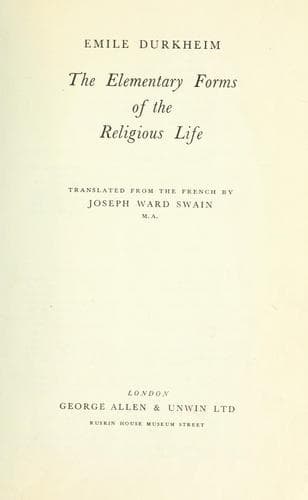
The Elementary Forms of the Religious LifeDurkheim, Émile
Religion
The Elementary Forms of the Religious Life
Durkheim, Émile
Cults; Religion; Religion -- Philosophy; Rites and ceremonies; Totemism
Even if society were unable to obtain these concessions and sacrifices
from us except by a material constraint, it might awaken in us only the
idea of a physical force to which we must give way of necessity, instead
of that of a moral power such as religions adore. But as a matter of
fact, the empire which it holds over consciences is due much less to the
physical supremacy of which it has the privilege than to the moral
authority with which it is invested. If we yield to its orders, it is
not merely because it is strong enough to triumph over our resistance;
it is primarily because it is the object of a venerable respect.
We say that an object, whether individual or collective, inspires
respect when the representation expressing it in the mind is gifted with
such a force that it automatically causes or inhibits actions, _without
regard for any consideration relative to their useful or injurious
effects_. When we obey somebody because of the moral authority which we
recognize in him, we follow out his opinions, not because they seem
wise, but because a certain sort of physical energy is imminent in the
idea that we form of this person, which conquers our will and inclines
it in the indicated direction. Respect is the emotion which we
experience when we feel this interior and wholly spiritual pressure
operating upon us. Then we are not determined by the advantages or
inconveniences of the attitude which is prescribed or recommended to us;
it is by the way in which we represent to ourselves the person
recommending or prescribing it. This is why commands generally take a
short, peremptory form leaving no place for hesitation; it is because,
in so far as it is a command and goes by its own force, it excludes all
idea of deliberation or calculation; it gets its efficacy from the
intensity of the mental state in which it is placed. It is this
intensity which creates what is called a moral ascendancy.
Public-domain text, read in full here on John Shaqi.
Reviews
Reviews
No reviews yet
Be the first to share your thoughts on this work.
Elsewhere in the archive
Join the Discussion
Join the discussion
Sign in to leave a comment or review.
Sign InorCreate an account