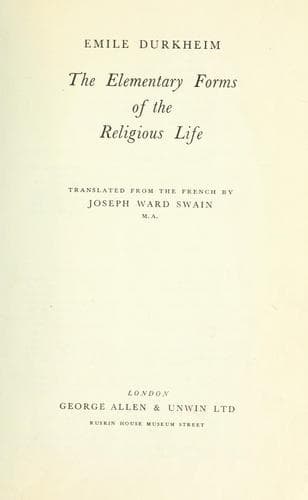
The Elementary Forms of the Religious LifeDurkheim, Émile
Religion
The Elementary Forms of the Religious Life
Durkheim, Émile
Cults; Religion; Religion -- Philosophy; Rites and ceremonies; Totemism
Since it is in spiritual ways that social pressure exercises itself, it
could not fail to give men the idea that outside themselves there exist
one or several powers, both moral and, at the same time, efficacious,
upon which they depend. They must think of these powers, at least in
part, as outside themselves, for these address them in a tone of command
and sometimes even order them to do violence to their most natural
inclinations. It is undoubtedly true that if they were able to see that
these influences which they feel emanate from society, then the
mythological system of interpretations would never be born. But social
action follows ways that are too circuitous and obscure, and employs
psychical mechanisms that are too complex to allow the ordinary observer
to see whence it comes. As long as scientific analysis does not come to
teach it to them, men know well that they are acted upon, but they do
not know by whom. So they must invent by themselves the idea of these
powers with which they feel themselves in connection, and from that, we
are able to catch a glimpse of the way by which they were led to
represent them under forms that are really foreign to their nature and
to transfigure them by thought.
But a god is not merely an authority upon whom we depend; it is a force
upon which our strength relies. The man who has obeyed his god and who,
for this reason, believes the god is with him, approaches the world with
confidence and with the feeling of an increased energy. Likewise, social
action does not confine itself to demanding sacrifices, privations and
efforts from us. For the collective force is not entirely outside of us;
it does not act upon us wholly from without; but rather, since society
cannot exist except in and through individual consciousnesses,[682] this
force must also penetrate us and organize itself within us; it thus
becomes an integral part of our being and by that very fact this is
elevated and magnified.
Public-domain text, read in full here on John Shaqi.
Reviews
Reviews
No reviews yet
Be the first to share your thoughts on this work.
Elsewhere in the archive
Join the Discussion
Join the discussion
Sign in to leave a comment or review.
Sign InorCreate an account