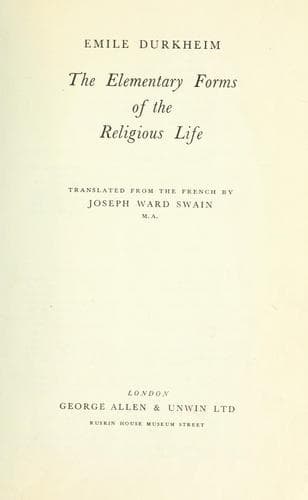
The Elementary Forms of the Religious LifeDurkheim, Émile
Religion
The Elementary Forms of the Religious Life
Durkheim, Émile
Cults; Religion; Religion -- Philosophy; Rites and ceremonies; Totemism
Yet the powers which are thus conferred, though purely ideal, act as
though they were real; they determine the conduct of men with the same
degree of necessity as physical forces. The Arunta who has been rubbed
with his churinga feels himself stronger; he is stronger. If he has
eaten the flesh of an animal which, though perfectly healthy, is
forbidden to him, he will feel himself sick, and may die of it. Surely
the soldier who falls while defending his flag does not believe that he
sacrifices himself for a bit of cloth. This is all because social
thought, owing to the imperative authority that is in it, has an
efficacy that individual thought could never have; by the power which it
has over our minds, it can make us see things in whatever light it
pleases; it adds to reality or deducts from it according to the
circumstances. Thus there is one division of nature where the formula of
idealism is applicable almost to the letter: this is the social kingdom.
Here more than anywhere else, the idea is the reality. Even in this
case, of course, idealism is not true without modification. We can never
escape the duality of our nature and free ourselves completely from
physical necessities: in order to express our own ideas to ourselves, it
is necessary, as has been shown above, that we fix them upon material
things which symbolize them. But here the part of matter is reduced to a
minimum. The object serving as support for the idea is not much in
comparison with the ideal superstructure, beneath which it disappears,
and also, it counts for nothing in the superstructure. This is what that
pseudo-delirium consists in, which we find at the bottom of so many
collective representations: it is only a form of this essential
idealism.[716] So it is not properly called a delirium, for the ideas
thus objectified are well founded, not in the nature of the material
things upon which they settle themselves, but in the nature of society.
Public-domain text, read in full here on John Shaqi.
Reviews
Reviews
No reviews yet
Be the first to share your thoughts on this work.
Elsewhere in the archive
Join the Discussion
Join the discussion
Sign in to leave a comment or review.
Sign InorCreate an account