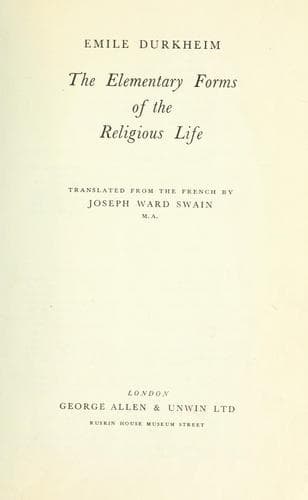
The Elementary Forms of the Religious LifeDurkheim, Émile
Religion
The Elementary Forms of the Religious Life
Durkheim, Émile
Cults; Religion; Religion -- Philosophy; Rites and ceremonies; Totemism
ethnographers,[36] systematically makes reference.
But howsoever evident this definition may appear, thanks to the mental
habits which we owe to our religious education, there are many facts to
which it is not applicable, but which appertain to the field of religion
nevertheless.
In the first place, there are great religions from which the idea of
gods and spirits is absent, or at least, where it plays only a secondary
and minor rôle. This is the case with Buddhism. Buddhism, says Burnouf,
"sets itself in opposition to Brahmanism as a moral system without god
and an atheism without Nature."[37] "As it recognizes not a god upon
whom man depends," says Barth, "its doctrine is absolutely
atheistic,"[38] while Oldenberg, in his turn, calls it "a faith without
a god."[39] In fact, all that is essential to Buddhism is found in the
four propositions which the faithful call the four noble truths.[40] The
first states the existence of suffering as the accompaniment to the
perpetual change of things; the second shows desire to be the cause of
suffering; the third makes the suppression of desire the only means of
suppressing sorrow; the fourth enumerates the three stages through which
one must pass to attain this suppression: they are uprightness,
meditation, and finally wisdom, the full possession of the doctrine.
These three stages once traversed, one arrives at the end of the road,
at the deliverance, at salvation by the Nirvâna.
Now in none of these principles is there question of a divinity. The
Buddhist is not interested in knowing whence came the world in which he
lives and suffers; he takes it as a given fact,[41] and his whole
concern is to escape it. On the other hand, in this work of salvation,
he can count only upon himself; "he has no god to thank, as he had
previously no god to invoke during his struggle."[42] Instead of
praying, in the ordinary sense of the term, instead of turning towards a
superior being and imploring his assistance, he relies upon himself and
meditates. This is not saying "that he absolutely denies the existence
of the beings called Indra, Agni and Varuna;[43] but he believes that he
owes them nothing and that he has nothing to do with them," for their
power can only extend over the goods of this world, which are without
value for him. Then he is an atheist, in the sense that he does not
concern himself with the question whether gods exist or not. Besides,
even if they should exist, and with whatever powers they might be armed,
the saint or the emancipated man regards himself superior to them; for
that which causes the dignity of beings is not the extent of the action
they exercise over things, but merely the degree of their advancement
upon the road of salvation.[44]
Public-domain text, read in full here on John Shaqi.
Reviews
Reviews
No reviews yet
Be the first to share your thoughts on this work.
Join the Discussion
Join the discussion
Sign in to leave a comment or review.
Sign InorCreate an account