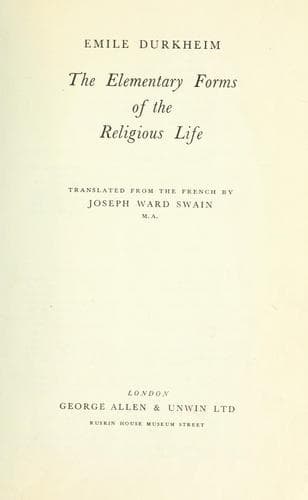
The Elementary Forms of the Religious LifeDurkheim, Émile
Religion
The Elementary Forms of the Religious Life
Durkheim, Émile
Cults; Religion; Religion -- Philosophy; Rites and ceremonies; Totemism
All known religious beliefs, whether simple or complex, present one
common characteristic: they presuppose a classification of all the
things, real and ideal, of which men think, into two classes or opposed
groups, generally designated by two distinct terms which are translated
well enough by the words _profane_ and _sacred_ (_profane_, _sacré_).
This division of the world into two domains, the one containing all that
is sacred, the other all that is profane, is the distinctive trait of
religious thought; the beliefs, myths, dogmas and legends are either
representations or systems of representations which express the nature
of sacred things, the virtues and powers which are attributed to them,
or their relations with each other and with profane things. But by
sacred things one must not understand simply those personal beings which
are called gods or spirits; a rock, a tree, a spring, a pebble, a piece
of wood, a house, in a word, anything can be sacred. A rite can have
this character; in fact, the rite does not exist which does not have it
to a certain degree. There are words, expressions and formulæ which can
be pronounced only by the mouths of consecrated persons; there are
gestures and movements which everybody cannot perform. If the Vedic
sacrifice has had such an efficacy that, according to mythology, it was
the creator of the gods, and not merely a means of winning their favour,
it is because it possessed a virtue comparable to that of the most
sacred beings. The circle of sacred objects cannot be determined, then,
once for all. Its extent varies infinitely, according to the different
religions. That is how Buddhism is a religion: in default of gods, it
admits the existence of sacred things, namely, the four noble truths and
the practices derived from them.[65]
Up to the present we have confined ourselves to enumerating a certain
number of sacred things as examples: we must now show by what general
characteristics they are to be distinguished from profane things.
Public-domain text, read in full here on John Shaqi.
The Elementary Forms of the Religious Life — John Shaqi
Reviews
Reviews
No reviews yet
Be the first to share your thoughts on this work.
Join the Discussion
Join the discussion
Sign in to leave a comment or review.
Sign InorCreate an account