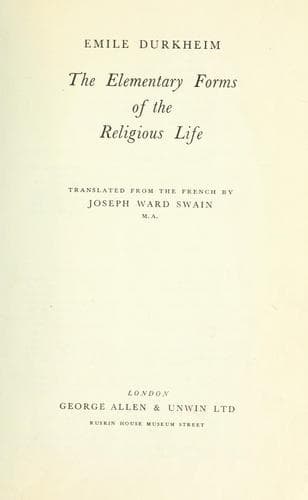
The Elementary Forms of the Religious LifeDurkheim, Émile
Religion
The Elementary Forms of the Religious Life
Durkheim, Émile
Cults; Religion; Religion -- Philosophy; Rites and ceremonies; Totemism
The Intichiuma ceremony in the tribes of Central Australia--
Different forms which it presents 326
I.--The Arunta Form--The two phases--Analysis of the first: visit
to sacred places, scattering of sacred dust, shedding of blood,
etc., to assure the reproduction of the totemic species 327
II.--Second phase: ritual consumption of the totemic plant or
animal 333
III.--Interpretation of the complete ceremony--The second rite
consists in a communion meal--Reason for this communion 336
IV.--The rites of the first phase consists in oblations--Analogies
with sacrificial oblations--The Intichiuma thus contains the two
elements of sacrifice--Interest of these facts for the theory of
sacrifice 340
V.--On the pretended absurdity of sacrificial oblations--How
they are explained: dependence of sacred beings upon their
worshippers--Explanation of the circle in which sacrifice seems
to move--Origin of the periodicity of positive rites 344
CHAPTER III
THE POSITIVE CULT--(_continued_)
II.--_Imitative Rites and the Principle of Causality_
I.--Nature of the imitative rites--Examples of ceremonies where
they are employed to assure the fertility of the species 351
II.--They rest upon the principle: _like produces like_--
Examination of the explanation of this given by the
anthropological school--Reasons why they imitate the animal
or plant--Reasons for attributing a physical efficacy to these
gestures--Faith--In what sense it is founded upon experience--
The principles of magic are born in religion 355
III.--The preceding principle considered as one of the first
statements of the principle of causality--Social conditions
upon which this latter depends--The idea of impersonal force or
power is of social origin--The necessity for the conception of
causality explained by the authority inherent in social
imperatives 362
CHAPTER IV
THE POSITIVE CULT--(_continued_)
III.--_Representative or Commemorative Rites_
I.--Representative rites with physical efficacy--Their relations
with the ceremonies already described--Their action is wholly
moral 371
II.--Representative rites without physical efficacy--They confirm
the preceding results--The element of recreation in religion:
its importance; its reason for existence--The idea of a feast 376
III.--Ambiguity of function in the various ceremonies studied;
they substitute themselves for each other--How this ambiguity
confirms the theory proposed 383
CHAPTER V
Public-domain text, read in full here on John Shaqi.
Reviews
Reviews
No reviews yet
Be the first to share your thoughts on this work.
Join the Discussion
Join the discussion
Sign in to leave a comment or review.
Sign InorCreate an account