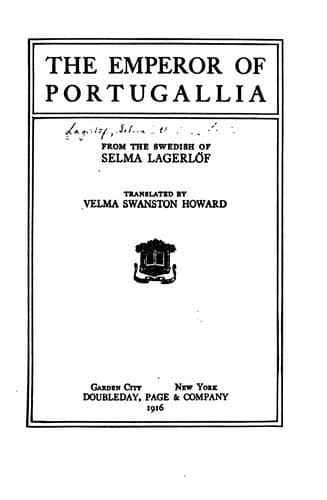
Fathers and daughters -- Fiction; Sweden -- Fiction; Swedish fiction -- Translations into English
"I'm right and fit again," Agrippa told him. "But I know well
enough that if you and Katrina had not come to the rescue there
wouldn't have been much left of Johan Utter Agrippa Prästberg by
now. So I've wondered what I could do for you in return."
"Oh, don't give that a thought my good Agrippa Prästberg!" said
Jan, with that upward imperial sweep of the hand.
"Hush now, while I tell you!" spoke Prästberg. "When I said I'd
thought of doing you a return service, it wasn't just empty
chatter. I meant it. And now it has already been done. The other
day I ran across the travelling salesman who gave that lass of
yours the red dress."
"Who?" cried Jan, so excited he could hardly get his breath.
"That blackguard who gave the girl the red dress and who afterward
sent her to the devil in Stockholm. First I gave him, on your
account, all the thrashing he could take, and then I told him that
the next time he showed his face around here he'd get just as big a
dose of the same kind of medicine."
Jan would not believe he had heard aright. "But what did he say?"
he questioned eagerly. "Didn't you ask him about Glory Goldie? Had
he no greetings from her?"
"What could he say? He took his punishment and held his tongue. Now
I've done you a decent turn, Jan Anderson, and we're even. Johan
Utter Agrippa Prästberg wants no unpaid scores."
With that he strode on, leaving Jan in the middle of the road,
lamenting loudly. The little girl had wanted to send him a message!
That merchant had come with greetings from her, but not a thing had
he learned because the man had been driven away.
Jan stood wringing his hands. He did not weep, but he ached all
over worse than if he were ill. He felt certain in his own mind
that Glory Goldie had wanted Prästberg to take a message from her
brought by the merchant and convey it to her father. But it was
with Prästberg as with the trolls--whether they wanted to help or
hinder they only wrought mischief.
THE SUNDAY AFTER MIDSUMMER
The first Sunday after Midsummer Day there was a grand party at the
seine-maker's to which every one in the Ashdales had been invited.
The old man and his daughter-in-law were in the habit of
entertaining the whole countryside on this day of each year.
Folks wondered, of course, how two people who were so pitiably poor
could afford to give a big feast, but to all who knew the whys and
wherefores it seemed perfectly natural.
Public-domain text, read in full here on John Shaqi.
Reviews
Reviews
No reviews yet
Be the first to share your thoughts on this work.
Elsewhere in the archive
Join the Discussion
Join the discussion
Sign in to leave a comment or review.
Sign InorCreate an account