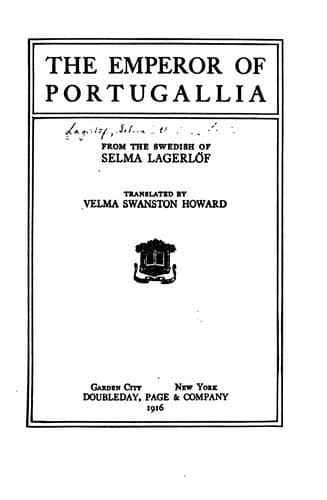
Fathers and daughters -- Fiction; Sweden -- Fiction; Swedish fiction -- Translations into English
As a matter of fact, when the seine-maker was a rich man he gave
his two sons a farmstead each. The elder son wasted his substance
in much the same way as Ol' Bengtsa himself had done, and died
poor. The younger son, who was the more steady and reliable, kept
his portion and even increased it, so that now he was quite well-to-do.
But what he owned at the present time was as nothing to what he
might have had if his father had not recklessly made away with both
money and lands, to no purpose whatever. If such wealth had only
come into the hands of the son in his younger days, there is no
telling to what he might have attained. He could have been owner of
all the woodlands in the Lovsjö district, had a shop at Broby, and
a steamer plying Lake Löven; he might even have been master of the
ironworks at Ekeby. Naturally he found it difficult to excuse the
father's careless business methods, but he kept his thoughts to
himself.
When the crash came for Ol' Bengtsa, a good many persons, Bengtsa
among them, expected the son to come to his aid by the sacrifice of
his own property. But what good would that have done? It would only
have gone to the creditors. It was with the idea in mind that the
father should have something to fall back upon when all his
possessions were gone, that the son had held on to his own.
It was not the fault of the younger son that Ol' Bengtsa had taken
up his abode with the widow of the elder son, for he had begged the
father more than a hundred times to come and live with him. The
father's refusal to accept this offer seemed almost like an act of
injustice; for because of it the son got the name of being mean and
hard-hearted among those who knew the old man was badly off. Still,
there was no ill-feeling between the two.
The son, accompanied by his wife and children, always drove down to
the Ashdales over the steep and perilous mountain road once every
summer, just to spend a day with his father.
If people had only known how badly he and his wife felt every time
they saw the wretched hovel, the ramshackle outhouse, the stony
potato patch, and the sister-in-law's ragged children, they would
have understood how his heart went out to his father. The worst of
all was that the father persisted in giving a big party in their
honour. Every time they bade the old man good-bye they begged him
not to invite all the neighbours in when they came again the next
year; but he was obdurate; he would not forego his yearly feast,
though he could ill afford the expense. Seeing how aged and broken
he looked, one would hardly have thought there was so much of the
old happy-go-lucky Ol' Bengtsa of Lusterby still left in him, but
the desire to do things on a grand scale still clung to him. It had
caused him misfortune from which he could never recover.
Public-domain text, read in full here on John Shaqi.
Reviews
Reviews
No reviews yet
Be the first to share your thoughts on this work.
Elsewhere in the archive
Join the Discussion
Join the discussion
Sign in to leave a comment or review.
Sign InorCreate an account