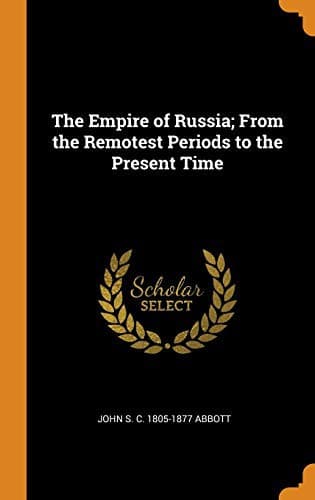
The Empire of Russia: From the Remotest Periods to the Present TimeAbbott, John S. C. (John Stevens Cabot)
History
The Empire of Russia: From the Remotest Periods to the Present Time
Abbott, John S. C. (John Stevens Cabot)
Russia -- History
Anguish of body and of soul seems now to have changed the nature of
Vassali, and with energy, disinterestedness and wisdom undeveloped
before, he consecrated himself to the welfare of his country. He
associated with himself his young son Ivan, who subsequently attained
the title of the Great. "But Chemyaka," writes Karamsin, "still lived,
and his heart, ferocious, implacable, sought new means of vengeance.
His death seemed necessary for the safety of the state, and some one
gave him poison, of which he died the next day. The author, of an
action so contrary to religion, to the principles of morality and of
honor, remains unknown. A lawyer, named Beda, who conveyed the news of
his death to Moscow, was elevated to the rank of secretary by the
grand prince, who exhibited on that occasion an indiscreet joy." On
the 14th of March, 1462, Vassali terminated his eventful and
tumultuous life, at the age of forty-seven. His reign was during one
of the darkest periods in the Russian annals. Life to him, and to his
cotemporaries, was but a pitiless tempest, through which hardly one
ray of sunshine penetrated. It was under his reign that the horrible
punishment of the _knout_ was introduced into Moscow, a barbaric mode
of scourging unknown to the ancient Russians. Fire-arms were also
beginning to be introduced, which weapons have diminished rather than
increased the carnage of fields of battle.
CHAPTER X.
THE ILLUSTRIOUS IVAN III.
From 1462 to 1480.
Ivan III.--His Precocity and Rising Power.--The Three Great
Hordes.--Russian Expedition Against Kezan.--Defeat of the
Tartars.--Capture of Constantinople by the Turks.--The Princess
Sophia.--Her Journey to Russia, and Marriage with Ivan
III.--Increasing Renown of Russia.--New Difficulty with the
Horde.--The Tartars Invade Russia.--Strife on the Banks of the
Oka.--Letter of the Metropolitan Bishop.--Unprecedented
Panic.--Liberation of Russia.
In the middle of the fifteenth century, Constantinople was to Russia
what Paris, in the reign of Louis XIV., was to modern Europe. The
imperial city of Constantine was the central point of ecclesiastical
magnificence, of courtly splendor, of taste, of all intellectual
culture.[4] To the Greeks the Russians were indebted for their
religion, their civilization and their social culture.
[Footnote 4: Karamsin, vol. ix., p. 436.]
Public-domain text, read in full here on John Shaqi.
Reviews
Reviews
No reviews yet
Be the first to share your thoughts on this work.
Elsewhere in the archive
Join the Discussion
Join the discussion
Sign in to leave a comment or review.
Sign InorCreate an account