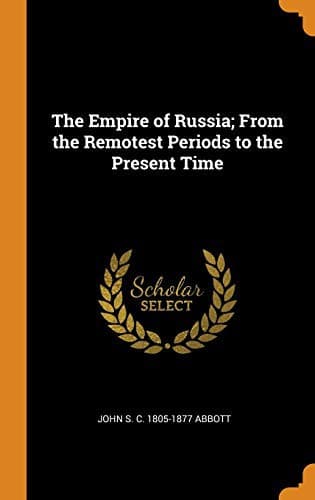
The Empire of Russia: From the Remotest Periods to the Present TimeAbbott, John S. C. (John Stevens Cabot)
History
The Empire of Russia: From the Remotest Periods to the Present Time
Abbott, John S. C. (John Stevens Cabot)
Russia -- History
Ivan III., who had for some time been associated with his father in
the government, was now recognized as the undisputed prince of the
grand principality, though his sway over the other provinces of Russia
was very feeble, and very obscurely defined. At twelve years of age,
Ivan was married to Maria, a princess of Tver. At eighteen years of
age he was the father of a son, to whom he gave his own name. When he
had attained the age of twenty-two years, his father died, and the
reins of government passed entirely into his hands. From his earliest
years, he gave indications of a character of much more than ordinary
judgment and maturity. Upon his accession to the throne, he not only
declined making any appeal to the khan for the ratification of his
authority, but refused to pay the tribute which the horde had so long
extorted. The result was, that the Tartars were speedily rallying
their forces, with vows of vengeance. But on the march, fortunately
for Russia, they fell into a dispute among themselves, and exhausted
their energies in mutual slaughter.
According to the Greek chronology, the world was then approaching the
end of the seven thousandth year since the creation, and the
impression was universal that the end of the world was at hand. It is
worthy of remark that this conviction seemed rather to increase
recklessness and crime than to be promotive of virtue. Bat the years
glided on, and gradually the impression faded away. Ivan, with
extraordinary energy and sagacity, devoted himself to the
consolidation of the Russian empire, and the development of all its
sources of wealth. The refractory princes he assailed one by one, and,
favored by a peculiar combination of circumstances, succeeded in
chastising them into obedience.
The great Mogol power was essentially concentrated in three immense
hordes. All these three combined when there was a work of national
importance to be achieved. The largest of the hordes, and the most
eastern, spread over a region of undefined extent, some hundreds of
miles east of the Caspian Sea. The most western occupied a large
territory upon the Volga and the Kama, called Kezan. From this, their
encampment, where they had already erected many flourishing cities,
enriched by commerce with India and Greece, they were continually
ravaging the frontiers of Russia, often penetrating the country three
or four hundred miles, laying the largest cities in ashes, and then
retiring laden with plunder and prisoners. This encampment of the
horde was but five hundred miles east of Moscow; but much of the
country directly intervening was an uninhabited waste, so great was
the terror which the barbarians inspired.
Public-domain text, read in full here on John Shaqi.
Reviews
Reviews
No reviews yet
Be the first to share your thoughts on this work.
Elsewhere in the archive
Join the Discussion
Join the discussion
Sign in to leave a comment or review.
Sign InorCreate an account