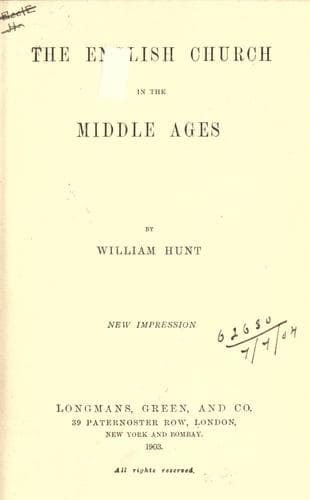
The English Church in the Middle AgesHunt, William
History
The English Church in the Middle Ages
Hunt, William
Church history -- Middle Ages, 600-1500; Great Britain -- Church history
constitutions of Stephen Langton, of the legates Otho and Ottoboni, of
Boniface of Savoy, and other archbishops. In some of these a considerable
advance in the pretensions of the clergy is evident. The work of Edward I.
in assigning the clerical estate its place in the scheme of national
government, in forcing it to bear its own (often an unduly large) share in
the national burdens, and in limiting and defining the area of clerical
jurisdiction and lawful pretensions so as to prevent them from trenching
on the national system, will form the main subject of the next chapter.
CHAPTER VIII.
_THE CHURCH AND THE NATION._
CHARACTER OF THE REIGN OF EDWARD I.--ARCHBISHOP PECKHAM--STATUTE OF
MORTMAIN--CONQUEST OF WALES--CIRCUMSPECTE AGATIS--EXPULSION OF THE
JEWS--CLERICAL TAXATION AND REPRESENTATION IN PARLIAMENT--BREACH
BETWEEN THE CROWN AND THE PAPACY--CONFIRMATION OF THE
CHARTERS--ARCHBISHOP WINCHELSEY AND THE RIGHTS OF THE CROWN--THE
ENGLISH PARLIAMENT AND PAPAL EXACTIONS--CHURCH AND STATE DURING THE
REIGN OF EDWARD II.--PAPAL PROVISIONS TO BISHOPRICS--THE BISHOPS AND
SECULAR POLITICS--THE PROVINCE OF YORK--PARLIAMENT AND CONVOCATION.
[Sidenote: Edward I., 1272-1307.]
In the reign of Edward I. the relations between the Church and the Crown
were defined and settled on a constitutional basis, and the clergy were
assigned their own place in the national system. The king was a great
lawgiver, and out of a chaotic mass of customs and institutions chose
those best adapted to create an orderly polity, in which every class of
men fitted for political purposes had its own share both of rights and
duties. At the same time, he had no intention of giving up any of the
prerogatives of the Crown, for he both loved power for its own sake and
was in constant need of money. His reign was, therefore, full of
struggles with those to whom he was giving ascertained rights to share in
the government. He met with considerable opposition from the clergy, for
the influence of the mendicant revival was directed to uphold the papal
pretensions, and as far as possible to render the Church independent of
the State. The main history of his struggles with the clergy assumes two
distinct phases during the periods of the archiepiscopates of Peckham and
Winchelsey. Peckham contended chiefly for the privileges of the National
Church; and the king, who still remained in accord with Rome, got the
better of him, and prevented clerical privilege from hindering his scheme
of national government. Fortunately for the Church and the nation, the
hold of the Pope upon the country was loosened by the breach of the accord
between the papacy and the Crown which had existed ever since the
submission of John. This breach was brought about by the extravagant
pretensions of Rome. During the latter part of the reign, Winchelsey
endeavoured to uphold these pretensions, as he was to some extent bound to
do by his office.
Public-domain text, read in full here on John Shaqi.
Reviews
Reviews
No reviews yet
Be the first to share your thoughts on this work.
Elsewhere in the archive
Join the Discussion
Join the discussion
Sign in to leave a comment or review.
Sign InorCreate an account