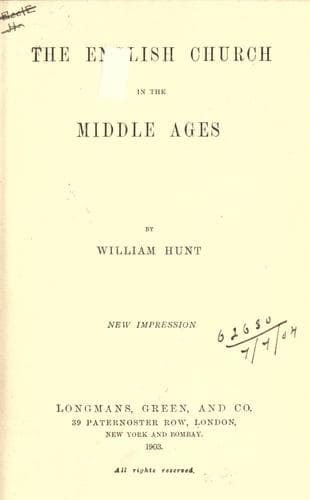
The English Church in the Middle AgesHunt, William
History
The English Church in the Middle Ages
Hunt, William
Church history -- Middle Ages, 600-1500; Great Britain -- Church history
He did not, however, confine himself, as Peckham had
done, simply to an ecclesiastical policy; for he took a leading part in
various attempts to diminish the power of the Crown, and sought to secure
a separate position for the Church, with the Pope instead of the king as
her ruler, by allying himself with the party of opposition. Edward was
forced to yield to the political demands made upon him; but he
successfully maintained the rights of the Crown over the Church, and
punished the archbishop for the part he had taken against him. The clergy
equally with the laity had to bear their share of the national burdens;
the claims of Rome were defeated, and the parliament set out on the course
of resistance to the papal usurpations which found its completion in the
sixteenth century.
[Sidenote: Archbishop Kilwardby, 1273; res. 1278.]
[Sidenote: Archbishop Peckham, 1279-1292.]
During the early years of Edward's reign matters went on smoothly between
the Church and the Crown. Gregory X. was the king's friend, and had
accompanied him on his crusade; and his chief adviser and chancellor was
Robert Burnell, a churchman of great ability and wisdom, who thoroughly
understood how to forward his master's ecclesiastical policy. Before
Edward became king he had endeavoured to prevail on the monks of Christ
Church to elect Burnell to succeed Archbishop Boniface. Nevertheless they
chose another as archbishop; the king refused his assent to the election,
and Gregory, to put an end to the vacancy, appointed Robert Kilwardby, a
Dominican friar. Kilwardby, however, was by no means sufficiently vigorous
in asserting the rights of the Church to satisfy Nicolas III., and allowed
the privileges of the clergy in matters of jurisdiction to be curtailed by
statute. Nicolas accordingly raised him to the cardinalate in 1278, called
him to Rome, and thus forced him to resign the archbishopric. Edward
secured the election of his friend and minister, Burnell, then bishop of
Bath and Wells, and urged the Pope to confirm it. He was again foiled; for
Nicolas, after causing inquiries to be made as to the fitness of the
archbishop-elect, informed the king that he could not assent to his
request, and appointed John Peckham, the provincial of the English
Franciscans, laying down the rule that, as the death of a prelate at Rome
had long been held to give the Pope the right of appointing a successor, a
resignation, which was, he declared, an analogous event, had the same
effect.
Public-domain text, read in full here on John Shaqi.
Reviews
Reviews
No reviews yet
Be the first to share your thoughts on this work.
Elsewhere in the archive
Join the Discussion
Join the discussion
Sign in to leave a comment or review.
Sign InorCreate an account