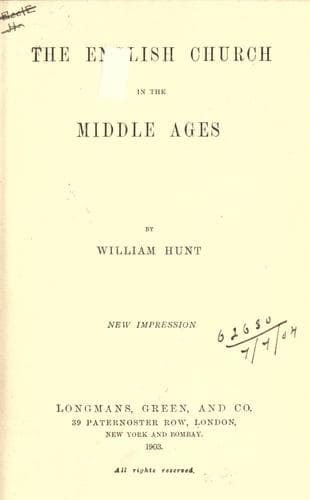
The English Church in the Middle AgesHunt, William
History
The English Church in the Middle Ages
Hunt, William
Church history -- Middle Ages, 600-1500; Great Britain -- Church history
It was, indeed, impossible, from the very nature of things, that Celtic
Christianity should long prevail in England, for its arrangements were
based on the loose organization of the sept, and the English needed
arrangements that suited kingship and tended towards political as well as
ecclesiastical union. Its rejection was, however, determined by questions
of Church order. Up to the middle of the fifth century the Celtic
Christians computed Easter by the Roman lunar cycle, which had gradually
diverged from that of Eastern Christendom. When, however, the Romans
adopted a new system of computation, the Welsh and the Irish Scots adhered
to the old cycle; and they further differed from the Roman Church as
regards the shape of the tonsure and the rites observed in the
administration of Baptism. Unimportant as such differences may seem to us,
they were really no light matters; for, as the Church was engaged in a
conflict with paganism, unity with itself was of the first consequence.
The points at issue began to be much debated in Northumbria when the
gentle-spirited Aidan was succeeded at Lindisfarne by Finan, a man of
violent temper. The Bernician court was divided. Oswiu was attached to the
Scottish communion, and his attachment was strengthened by his regard for
Colman, the successor of Finan. On the other hand, his queen, Eanflaed, the
daughter of Eadwine, belonged to the Roman party; and so it came about
that, while the king was keeping his Easter feast, his queen was still in
the Lenten fast. Oswiu's son, Alchfrith, who reigned as under-king in
Deira, left the Scottish communion and eagerly upheld the Roman party. He
was encouraged by Wilfrith, the abbot of Ripon. Wilfrith, who was the
child of wealthy parents, had been led by the unkindness of his stepmother
to desire to become a monk, and had been sent, when a handsome, clever lad
of thirteen, to Queen Eanflaed, that she might decide what he should do.
Eanflaed sent him to Lindisfarne, and he stayed there for some years. Then
she helped him to visit Rome, and he made the journey, which was as yet
unknown to his fellow-countrymen, partly in the company of Benedict
Biscop, who became the founder of Roman monasticism in the north of
England. While he was at Rome Wilfrith studied ecclesiastical matters, and
especially the subject of the computation of Easter. He returned home
fully convinced of the excellence of the Roman Church, and found in
Alchfrith a warm friend and willing disciple. Alchfrith had built a
monastery at Ripon, and peopled it with Scottish monks from Melrose. When
he adopted the Roman customs, these monks, of whom Cuthberht was one,
refused to follow his example, and accordingly he turned them out, and
gave the monastery to Wilfrith.
[Sidenote: The synod of Whitby, 664.]
Public-domain text, read in full here on John Shaqi.
Reviews
Reviews
No reviews yet
Be the first to share your thoughts on this work.
Join the Discussion
Join the discussion
Sign in to leave a comment or review.
Sign InorCreate an account