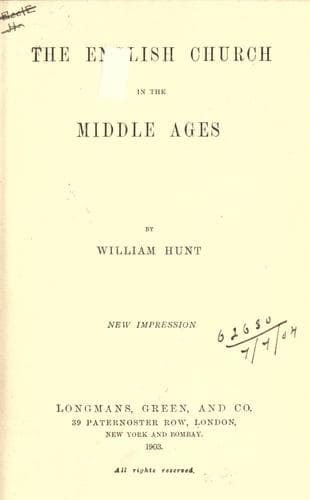
The English Church in the Middle AgesHunt, William
History
The English Church in the Middle Ages
Hunt, William
Church history -- Middle Ages, 600-1500; Great Britain -- Church history
No parliament met from 1373 until the Good Parliament of 1376. In this
parliament the party of reform was upheld by the Prince of Wales and the
bishop of Winchester. The Prince of Wales died during the session of the
parliament, and left the leaders of the party exposed to the vengeance of
John of Gaunt. A series of accusations was brought against Wykeham, his
temporalities were seized, and he was forbidden to come near the court.
Accordingly, he did not come up to the convocation of 1377, and Simon
Sudbury, the archbishop of Canterbury, refused to specially request his
attendance. His opposition was overruled by Courtenay, now bishop of
London, who dwelt on the injustice that had been done Wykeham by the
Crown, and urged the clergy to make no grant until he joined them. Wykeham
came up to convocation, and the king promised to redress his wrongs. And
here, at the point at which the quarrel assumes a new phase, when the
clergy were about to aim a blow at their enemy, John of Gaunt, by
attacking his ally, John Wyclif, at the opening of strife between Lollardy
and the Church, and at the beginning of a new era in the relations between
Rome and the English and other national Churches, brought about by the
papal Schism, this narrative reaches its appointed limit.
* * * * *
[Sidenote: Summary, 601-1066.]
[Sidenote: 601-664.]
[Sidenote: 663-829.]
Each period of the history we have been studying has some special
characteristics, and it may be convenient to sum them up briefly. The
partial failure of the Kentish mission and the break-down of Gregory's
scheme of government left the English Church in a disorganized condition,
and Rome had to win a second victory to save it from Celtic customs and
separation from the rest of Christendom. The hero of that victory was
Wilfrith, its token the restoration of the see of York. A new period opens
with the work of Theodore, and extends from the victory of the Roman
party at Whitby to the end of the greatness of the Northumbrian Church,
and the establishment of the sovereignty of Wessex. The diocesan scheme of
Theodore succeeded, and is the basis of our present arrangement. His
attempt to bring the whole Church under the rule of a single metropolitan
failed, for the northern Church was for a season more advanced than the
rest of the land in religion and culture; and its failure is marked by the
restoration of the see of York to metropolitan rank. From the first the
Church was national in character, independent of the rise and fall of the
petty kingdoms into which the land was divided, and it became a powerful
agent in the accomplishment of national unity. Nor was it by any means a
handmaid of Rome, for the attempt of Wilfrith to regain his position by
invoking the papal authority met with derision and defeat. From the first,
too, the Church and the civil power worked in complete harmony, and when
national unity was attained, the Church bore its own share in every
Public-domain text, read in full here on John Shaqi.
Reviews
Reviews
No reviews yet
Be the first to share your thoughts on this work.
Elsewhere in the archive
Join the Discussion
Join the discussion
Sign in to leave a comment or review.
Sign InorCreate an account