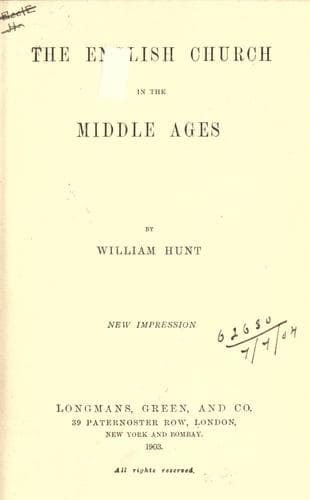
The English Church in the Middle AgesHunt, William
History
The English Church in the Middle Ages
Hunt, William
Church history -- Middle Ages, 600-1500; Great Britain -- Church history
Wilfrith appeared before the king and the archbishop, and demanded to be
told why he was thus deprived of his rights. No answer was given him, and
he appealed to the judgment of the Apostolic See. This appeal to Rome
against the decision of a king and his witan, and of an archbishop acting
in concert, the first that was ever made by an Englishman, is a notable
event. It was greeted with the jeers of the great men of the court.
Wilfrith went to Rome in person, and Theodore appeared by a proctor. Pope
Agatho and his council decreed that Wilfrith should be reinstated, that
his diocese should be divided, but that he should choose the new bishops,
and that Theodore's bishops should be turned out. Wilfrith returned in
triumph, bringing the papal decrees with their bulls (seals) attached. A
witenagemot was held to hear them, and the king and his nobles decided to
disregard them. Wilfrith was imprisoned, and Theodore made a further
division of his diocese by establishing a see at Abercorn, and appointed
bishops for Lindisfarne, Hexham, and perhaps Ripon without consulting him.
After Wilfrith was released he was forced by the hatred of Ecgfrith to
wander about seeking shelter, until at last he found it among the heathen
South Saxons. He converted them to Christianity, and lived as their bishop
at Selsey. Then he preached to the people of the Isle of Wight, and by
their conversion completed the work that Augustin came to do. The death of
Ecgfrith made it possible for Theodore to come to terms with him. The
archbishop and the injured bishop were reconciled in 686, and at
Theodore's request Ealdfrith, the new king of Northumbria, reinstated
Wilfrith as bishop of York. Nevertheless the division that Theodore had
made was not disturbed, and he only presided over the Deiran diocese.
After some years he and Ealdfrith had a dispute about the rights and
possessions of his see. He was again driven from York, and again appealed
to Rome. Pope Sergius took his part. But Ealdfrith, though a religious
man, was not more inclined to submit to papal interference than his
predecessor. He found an ally in Archbishop Brihtwald, for Theodore was
now dead, and in spite of the Pope's mandates, Wilfrith's claims were
rejected by a national synod of the Church. He again appealed to Rome, and
was excommunicated by the English bishops. Again he journeyed to Rome, and
John VI. pronounced a decree in his favour. Ealdfrith, however, declared
that he would never change his decision for papal writings, and it was not
until after his death that a compromise was effected in a Northumbrian
synod held on the Nidd in 705. The settlement was unfavourable to
Wilfrith, for he was not restored to York, but ended his days as bishop of
Hexham. He was a man of blameless life and indomitable courage. It was
mainly through his efforts that the Church of England was brought into
conformity with the Roman Church. Defeat never made him idle or
Public-domain text, read in full here on John Shaqi.
Reviews
Reviews
No reviews yet
Be the first to share your thoughts on this work.
Join the Discussion
Join the discussion
Sign in to leave a comment or review.
Sign InorCreate an account