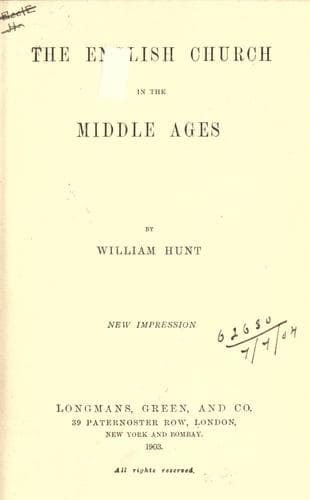
The English Church in the Middle AgesHunt, William
History
The English Church in the Middle Ages
Hunt, William
Church history -- Middle Ages, 600-1500; Great Britain -- Church history
Soon after the accession of Eadwig, in 956, Dunstan incurred the wrath of
a powerful enemy. At his consecration feast the boy-king left the hall for
the society of a young lady named AElfgifu and her mother, AEthelgifu, who
wished to make a match between him and her daughter. The great men were
wroth at this slight on themselves and on the kingly office, and sent
Dunstan to bring Eadwig back to the hall. Now there was some connexion
between Eadwig and AElfgifu that would have made their marriage unlawful,
and when Dunstan saw them together his zeal for purity was aroused; hot
words passed between him and the girl's mother, and he forced the king to
return to the banquet. In revenge AEthelgifu procured his banishment. He
found shelter in the abbey of St. Peter at Ghent, where for the first time
he saw the rule of St. Benedict fully carried out. While he was there, the
people of the north revolted from Eadwig, and chose his younger brother
Eadgar as king. Oda took advantage of this revolt to separate Eadwig from
AElfgifu, whom he had by this time married, and it is said that either she
or her mother--the story is late and uncertain--was cruelly slain by the
insurgents. This revolt of England north of the Thames and the division of
the kingdom have little or no ecclesiastical significance, for Oda
continued Eadwig's subject until his death. Eadgar, the "king of the
Mercians," called Dunstan back to England, and he was raised to the
episcopate. The circumstances of his elevation illustrate the unsettled
state of the custom as regards episcopal elections. Although no see was
vacant, the witan decreed that he should be made bishop, and he appears to
have been consecrated accordingly. Shortly afterwards the bishop of
Worcester died, and Dunstan was appointed his successor. A few months
later he received the bishopric of London, which he held along with
Worcester. In 959 Eadwig died, and Eadgar became king south of the Thames.
Then Brithelm, bishop of Wells, who had been appointed archbishop by
Eadwig, was sent back to his old diocese, and by the counsel of the witan
Dunstan was chosen archbishop in his stead.
[Sidenote: Seculars and regulars.]
Public-domain text, read in full here on John Shaqi.
Reviews
Reviews
No reviews yet
Be the first to share your thoughts on this work.
Join the Discussion
Join the discussion
Sign in to leave a comment or review.
Sign InorCreate an account