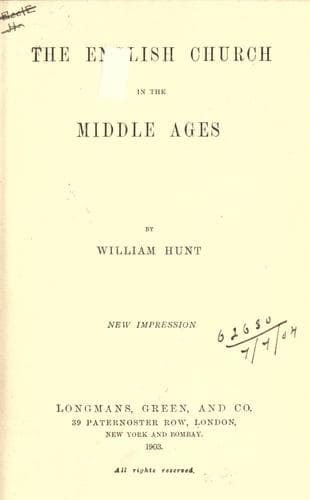
The English Church in the Middle Ages — John Shaqi
The English Church in the Middle AgesHunt, William
History
The English Church in the Middle Ages
Hunt, William
Church history -- Middle Ages, 600-1500; Great Britain -- Church history
On AElfric's death AElfheah was translated to Canterbury. The new archbishop
appears to have laboured to bring about a national reformation. Two
meetings of the witan were held, in which the ecclesiastical element was
evidently strong. During one of these the bishops and abbots met each day
for prayer and consultation, arranging probably the part they would take
in the discussions of the assembly. Decrees were made enjoining acts of
penitence and the observance of the day of the new saint, Eadward the
Martyr. All were to live righteously, were to love one God, uphold one
Christendom, and be true to one lord, the king. Measures were also taken
for the defence of the kingdom. Thus even a strictly ecclesiastical matter
like the observance of a "mass-day" was made a subject of legislation by
the national Council. At the same time the assembly was largely
ecclesiastical in character, and in its efforts after better things,
whether with regard to national unity and defence, or repentance and faith
towards God, seems to have followed the guidance of the rulers of the
Church.
[Sidenote: Martyrdom of Archbishop AElfheah, 1012.]
Efforts such as this, however, were rendered of no avail by the folly of
the king, the treachery of the nobles, and the disorganization of the
country. In 1011 Thurkill, who was then in command of a Danish fleet, was
promised a large sum of money if he would cease from his ravages. Payment
was delayed, and the Danes attacked Canterbury, sacked the city, burned
the cathedral, and carried off many captives, and among them the
archbishop. For seven months they kept AElfheah in their ships in chains,
hunger, and misery. At first he promised to ransom himself; but he
repented of this, for he thought of the sufferings of the people from whom
the money must be raised. While in captivity he spoke of Christ to those
who guarded him, and his words did not fall to the ground. The fleet lay
at Greenwich, and no money came either as tribute or for the ransom of the
archbishop. On 19th May 1012, the day on which the ransom was due, the
Danes made a feast, and drank deeply of some wine they had brought from
southern lands. Then they brought the archbishop forth and demanded the
ransom. He replied that he would pay nothing, that he was ready to suffer,
and that he commended his soul to God. Thurkill saw his danger, and tried
to save him, offering all he possessed, except his ship, for his life. But
they would not hearken, and pelted AElfheah with stones and the bones of
the oxen which they had eaten, until at last one who had been converted by
the archbishop, and whom he had confirmed the day before, put him out of
his agony by cleaving his head with his battle-axe. AElfheah did not die in
vain. Soon after his martyrdom Thurkill, whom we may believe he had
converted, declared himself a Christian, and brought his ships and their
crews to serve the English king. AElfheah laid down his life for the sake
Public-domain text, read in full here on John Shaqi.
Reviews
Reviews
No reviews yet
Be the first to share your thoughts on this work.
Join the Discussion
Join the discussion
Sign in to leave a comment or review.
Sign InorCreate an account