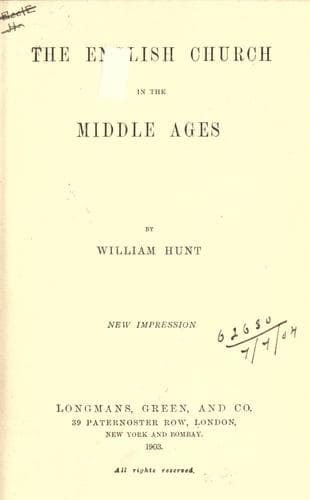
The English Church in the Middle AgesHunt, William
History
The English Church in the Middle Ages
Hunt, William
Church history -- Middle Ages, 600-1500; Great Britain -- Church history
The first William, if an austere man, was a mighty ruler, who loved order
and valued the services of good men: the second was a braggart and a
blasphemer, whose life was unspeakably evil and whose greediness knew no
shame. In his hands the royal supremacy became a hateful tyranny, and the
relations between the Church and the Crown were disturbed. Early in the
reign the change in these relations was illustrated by an appeal to Rome.
William of Saint-Calais, bishop of Durham, an ambitious and crafty
intriguer, was cited to appear before the king's court on a charge of
treason, and his lands were seized. He complained that his bishopric had
been seized, and Lanfranc, who upheld the king's action, answered that his
fiefs were not his bishopric. Next he pleaded the privilege of his order,
and refused to be judged by the lay barons. "If I may not judge you and
your order to-day," said Robert of Meulan, "you and your order shall never
judge me." If bishops refused the jurisdiction of the king's court, they
should cease to be members of it, they should no longer hold fiefs of the
Crown. Finally, William appealed to Rome. Archbishop Robert had in exile
appealed to the Pope against a decree of the national assembly; Bishop
William, for the first time since the days of Wilfrith, made a like appeal
in the presence of the king and his council. The sole object of Rufus was
to obtain Durham Castle; the bishop surrendered it, and was allowed to go
abroad, but he does not appear to have prosecuted his appeal.
[Sidenote: Feudal tyranny.]
Public-domain text, read in full here on John Shaqi.
Reviews
Reviews
No reviews yet
Be the first to share your thoughts on this work.
Elsewhere in the archive
Join the Discussion
Join the discussion
Sign in to leave a comment or review.
Sign InorCreate an account