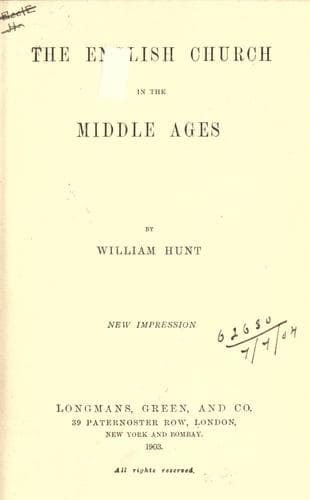
The English Church in the Middle AgesHunt, William
History
The English Church in the Middle Ages
Hunt, William
Church history -- Middle Ages, 600-1500; Great Britain -- Church history
The special danger which threatened the Church in this reign arose from
the attempt to treat it as a feudal society. Ralph Flambard, the minister
of Rufus, raised money for his master chiefly by exaggerating and
systematizing the feudal elements already existing in civil life. The
practice of granting the temporalities by investiture shows that, even
before the Conquest, Church lands were to some extent regarded in a feudal
light, and since then this idea had gained strength. Rufus treated them as
mere lay fiefs, and dealt with the prelates simply as his
tenants-in-chief. No profits could, of course, accrue to the Crown from
Church lands, such as were gathered from lay fiefs in the form of reliefs,
a payment made by the heir on entering on his estate, or from other
feudal burdens of a like kind. When, therefore, a bishopric or royal abbey
fell vacant, the king, to compensate himself for the disparity, instead of
causing the property to be administered for the benefit of the Church,
entered on the lands and treated them as his own. It thus became his
interest to keep sees vacant until he received a large sum for them.
Simony grew prevalent and the character of the clergy declined; they
engaged in secular pursuits, farmed the taxes, and sought in all ways to
make money. After the death of Lanfranc in 1089, the king kept the
archbishopric vacant, and granted the lands of the see to be held by his
friends or by the highest bidder. This was a different matter from his
dealings with other sees; for the archbishop was the spiritual head of the
nation, and constitutionally the chief adviser of the king and the
foremost member of his court, as he had been of the witenagemot.
Accordingly the barons saw the king's conduct with displeasure. Rufus was
not moved by greediness alone. While Lanfranc lived he had been forced to
listen to his remonstrances with respect, and as he hated reproof, he
determined not to appoint another archbishop as long as he could avoid
doing so. He would, he declared to one of his earls, be archbishop
himself. Neither the suffragan bishops nor the monks of Christ Church
dreamed of electing without his order, and each year the state of the
Church grew worse. At last Rufus fell sick and was like to die. Then the
bishops and nobles entreated him, for his soul's sake, to appoint a
primate and do other works meet for repentance. He consented willingly,
and they sent for Abbot Anselm, who chanced to be in England.
[Sidenote: S. Anselm, archbishop, 1093-1109.]
Public-domain text, read in full here on John Shaqi.
Reviews
Reviews
No reviews yet
Be the first to share your thoughts on this work.
Elsewhere in the archive
Join the Discussion
Join the discussion
Sign in to leave a comment or review.
Sign InorCreate an account