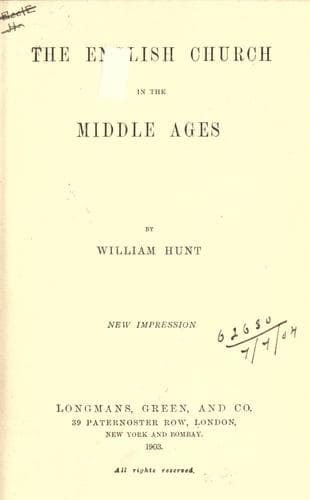
The English Church in the Middle AgesHunt, William
History
The English Church in the Middle Ages
Hunt, William
Church history -- Middle Ages, 600-1500; Great Britain -- Church history
where they were consulting. The archbishop escaped across the Thames in a
boat, and went abroad, and the king again seized the temporalities of the
see.
[Sidenote: Theobald, Archbishop, 1139-1161.]
[Sidenote: Study of civil law.]
Unlike Henry of Winchester, Theobald was guided by the new ideas which
were born of the Cistercian revival. While desire for the secular
greatness of the Church, her splendour and her wealth, led Henry to scheme
and change sides according as he found Stephen or the Empress acting
against her interests, Theobald sought a higher power for her, and
attached himself to Bernard, who ruled Christendom by his sanctity and his
intellectual gifts. Theobald's household was the home of a little society
of men of like mind with himself. One of them was a young clerk of London,
named Thomas, who soon became his chief adviser; another was John of
Salisbury, who held a new office, that of the archbishop's secretary, or,
as he would be called now, his chancellor; for Theobald saw that the
archdeacons were by no means trustworthy officers, and appointed a
secretary to control the administration of ecclesiastical law. This was a
matter in which he took a deep interest, and the frequent appeals that
were now made to Rome gave it a special importance. In 1149 he brought
over from Italy a doctor named Vacarius, and set him to give lectures at
Oxford on the civil law, which supplied the method of procedure in
ecclesiastical cases. In the next reign the study of the canon law, which
was first systematized by Gratian of Bologna, was introduced into England,
and then the clergy had a code as well as a method of procedure of their
own. Stephen sent Vacarius out of the country, probably because he hated
new things; but the study of the civil law could not be stopped so easily.
With aims and interests such as these, Theobald had no desire to see the
anarchy which is generally called Stephen's reign prolonged. How terrible
in some parts that anarchy was, when men "said openly that Christ and His
saints slept," need not be described here. Some of the bishops rode to war
and behaved like lay barons; others were held back by fear from censuring
the ungodly. Nevertheless the Church still exhibited a pattern of order,
and strove to restore peace to the kingdom. Although Theobald entered into
no schemes for dethroning Stephen, he was fully convinced of the
importance of securing the succession for Henry of Anjou. His counsellor,
Thomas, now archdeacon of Canterbury, was urgent on the same side, and
they were at last joined in their efforts after peace by Henry of
Winchester. The chief obstacle was removed by the death of Eustace, and
the Treaty of Wallingford soon followed. Henry II. owed his throne in no
small degree to the support of the clergy.
[Sidenote: Thomas the Chancellor.]
[Sidenote: Taxation of ecclesiastical knights' fees.]
Public-domain text, read in full here on John Shaqi.
Reviews
Reviews
No reviews yet
Be the first to share your thoughts on this work.
Elsewhere in the archive
Join the Discussion
Join the discussion
Sign in to leave a comment or review.
Sign InorCreate an account