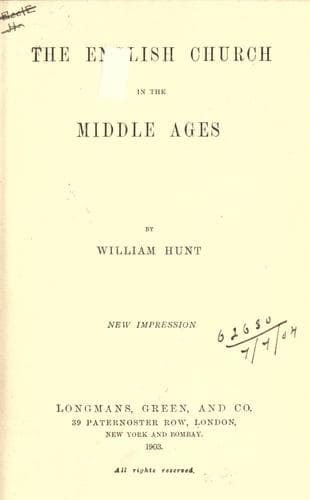
The English Church in the Middle AgesHunt, William
History
The English Church in the Middle Ages
Hunt, William
Church history -- Middle Ages, 600-1500; Great Britain -- Church history
The young king chose for his chancellor Thomas, the archdeacon, to whose
good offices he was much indebted. Thomas's father, Gilbert Becket, a
wealthy trader, had been port-reeve of London. Thomas was sent to school
at Merton priory, and was taken away from the school there while still
young because his parents suffered serious losses. Nevertheless he was
able to study at Paris, and after his return to England was often the
companion of a rich noble named Richer de l'Aigle, who took him out
hunting and hawking. As his father was now badly off, he became clerk to a
merchant, whose name in English was Eightpenny, and after a while was
introduced to the archbishop, entered his household, and soon became his
most trusted adviser. He took orders, and received many rich preferments.
As chancellor, he held one of the most important offices in the kingdom,
and his duties brought him into constant companionship with the king, who
treated him as an intimate friend. He was diligent in his secular work;
he loved magnificence, and lived with grace and splendour. No chancellor
had been so great a man before. He probably had a large share in the
reorganization of the administrative machinery. One change was certainly
due to him--the commutation of military service for a money payment. A
step in this direction was made in 1156, when Henry laid a tax called
scutage on Church lands held by knight's service. Theobald objected to
this imposition, but his objections were fruitless. Three years later,
when the king was undertaking a war in Toulouse, the chancellor advised
him to take money from all who owed him military service, instead of
calling upon them to go to the war. The general importance of this measure
does not belong to our subject; the scutage of Toulouse concerns us here
simply because it was levied on church-lands. It excited far more
indignation among the clergy than the earlier tax, because they saw that
it was the beginning of a system, not an isolated expedient. The
chancellor was held to have done the Church a grievous injury, and even
his friends traced his later troubles to his sin against her.
[Sidenote: Thomas, archbishop of Canterbury, 1162-1170.]
Public-domain text, read in full here on John Shaqi.
Reviews
Reviews
No reviews yet
Be the first to share your thoughts on this work.
Elsewhere in the archive
Join the Discussion
Join the discussion
Sign in to leave a comment or review.
Sign InorCreate an account