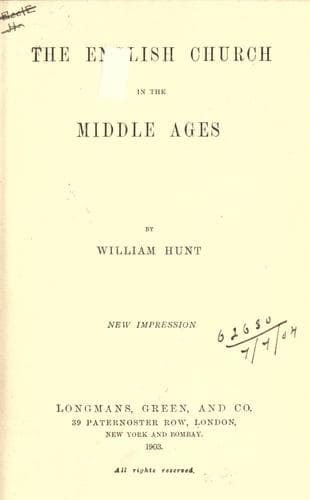
The English Church in the Middle AgesHunt, William
History
The English Church in the Middle Ages
Hunt, William
Church history -- Middle Ages, 600-1500; Great Britain -- Church history
Although the king of the East Angles received baptism in Kent at the
bidding of AEthelberht, he fell back into idolatry on his return to his own
land. And as AEthelberht's son, Eadbald, was a pagan, many of the
Kentishmen and East Saxons also deserted Christianity when he became king.
Eadbald was converted by Laurentius, and did what he could to forward the
cause of Christ. With AEthelberht's death, however, the greatness of Kent
passed away, and Eadbald could not insist on the destruction of idols even
in his own country. While Kent sank into political insignificance the
Kentish mission made one great advance, and then ended in failure. The
Northumbrian king, Eadwine, who reigned over the two Northumbrian
kingdoms, Bernicia and Deira, from the Forth to the Humber, and gradually
established a supremacy over the whole English people except the
Kentishmen, married AEthelburh, the daughter of AEthelberht. She was
accompanied to her new home by Paulinus, who was ordained bishop by
Justus, the successor of Mellitus; and Boniface V. wrote to her exhorting
her to labour for the conversion of her husband, and saying that he would
not cease to pray for her success. His prayers were heard; Eadwine was
baptized, and made his capital, York, the seat of the bishopric of
Paulinus. The people of Deira (Yorkshire) followed their king's example,
while Bernicia, though Paulinus preached and baptized there, remained, on
the whole, heathen; no church was built and no altar was raised. South of
the Humber the authority of Eadwine and the preaching of Paulinus effected
the conversion of Lindsey, and of the king, at least, of the East Angles.
In 633, however, Eadwine was defeated and slain by Penda, the heathen king
of Mercia, and Cadwallon, the Briton. Heathenism was already triumphant in
East Anglia, and on Eadwine's death many of the Northumbrians relapsed
into idolatry. AEthelburh and her children sought shelter in Kent, and
Paulinus fled with them. Only one Roman clergyman, the deacon James,
remained in Northumbria to labour on in faith that God's cause would yet
triumph there. Ignorant of the calamity that had befallen the Church, the
Pope, in pursuance of Gregory's scheme, sent the pall to Paulinus. When
the papal gift arrived in England the Church of York had been overthrown,
and Paulinus had been translated to Rochester.
[Sidenote: Independent missions.]
[Sidenote: Foundation of the see of Lindisfarne, 635.]
Public-domain text, read in full here on John Shaqi.
Reviews
Reviews
No reviews yet
Be the first to share your thoughts on this work.
Join the Discussion
Join the discussion
Sign in to leave a comment or review.
Sign InorCreate an account