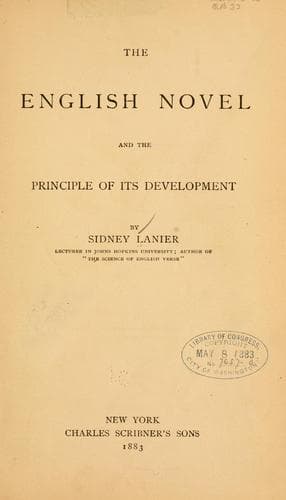
The English Novel and the Principle of its DevelopmentLanier, Sidney
History
The English Novel and the Principle of its Development
Lanier, Sidney
English fiction -- History and criticism
We must now hastily pass to the third so-called classic writer in
English fiction, Tobias Smollett, who, after being educated as a
surgeon, and having experiences of life as surgeon's mate on a ship
of the line in the expedition to Carthagena, spent some time in the
West Indies, returned to London, wrote some satire, an opera, &c., and
presently when he was still only twenty-seven years old captivated
England with his first novel, _Roderick Random_, which appeared, in
1748, the same year with _Clarissa Harlowe_. In 1751 came Smollett's
_Peregrine Pickle_, famous for its bright fun and the caricature it
contains of Akenside--_Pleasures of Imagination._ Akenside, who is
represented as the host in a very absurd entertainment after the
ancient fashion. In 1752 Smollett's _Adventures of Ferdinand Count
Fathom_ gave the world a new and very complete study in human
depravity. In 1769, appeared his _Adventures of an Atom_; a theme
which one might suppose it difficult to make indecorous; and which was
really a political satire; but the unfortunate liberty of locating his
atom as an organic particle in various parts of various successive
human bodies gave Smollett a field for indecency which he cultivated
to its utmost yield. A few months before his death in 1771 appeared
his _Expedition of Humphrey Clinker_, certainly his best novel. It is
worth while noticing that in Humphrey Clinker the veritable British
woman, poorly-educated and poor-spelling, begins to express herself in
the actual dialect of the species; and in the letters of Mrs. Winifred
Jenkins to her fellow-maid-servant Mrs. Mary Jones at Brambleton Hall,
during a journey made by the family to the North we have some very
worthy and strongly-marked originals not only of Mrs. Malaprop and
Mrs. Partington, but of the immortal Sairey Gamp and of scores of
other descendants in Thackeray and Dickens, here and there.
I can quote but a few lines from the last letter of Mrs. Winifred
Jenkins concluding the _Expedition of Humphrey Clinker_, which by the
way is told entirely through letters from one character to another,
like Richardson's.
"To Mrs. Mary Jones at Brambleton Hall,
Mrs. Jones,:--
Providence has bin pleased to make great halteration in the
pasture of our affairs. We were yesterday three kiple chined by
the grease of God in the holy bands of matter-money."
Public-domain text, read in full here on John Shaqi.
Reviews
Reviews
No reviews yet
Be the first to share your thoughts on this work.
Elsewhere in the archive
Join the Discussion
Join the discussion
Sign in to leave a comment or review.
Sign InorCreate an account