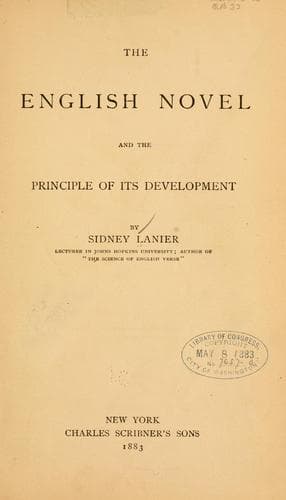
The English Novel and the Principle of its DevelopmentLanier, Sidney
History
The English Novel and the Principle of its Development
Lanier, Sidney
English fiction -- History and criticism
(The novel winds up with a general marriage of pretty much all
parties concerned, mistress, maid, master and man); "and I now
subscribe myself Loyd, at your sarvice." Here she of course
describes the wedding. "As for Madam Lashmiheygo, you nose her
picklearities--her head to be sure was fantastical; and her
spouse had wrapped her with a long ... clock from the land of the
selvedges.... Your humble servant had on a plain pea-green tabby
sack, with my runnela cap, ruff toupee, and side-curls. They said
I was the very moral of Lady Rickmanstone but not so pale--that
may well be, for her ladyship is my elder by seven good years or
more. Now, Mrs. Mary, our satiety is to suppurate; and we are
coming home"--which irresistibly reminds us of the later Mrs.
Malaprop's famous explanation in _The Rivals_:--"I was putrefied
with astonishment."--"Present my compliments to Mrs. Gwillim, and
I hope she and I will live upon dissent terms of civility. Being
by God's blessing removed to a higher spear you'll excuse my
being familiar with the lower sarvints of the family, but as I
trust you will behave respectful and keep a proper distance you
may always depend on the good will and protection of
Yours,
W. LOYD."
To these I have now only to add the name of Lawrence Sterne, whose
_Tristram Shandy_ appeared in 1759, in order to complete a group of
novel writers whose moral outcome is much the same, and who are still
reputed in all current manuals as the classic founders of English
fiction. I need give no characterization of Sterne's book, which is
probably best known of all the three. Every one recalls the Chinese
puzzle of humor in _Tristram Shandy_, which pops something grotesque
or indecent at us in every crook. As to its morality, I know good
people who love the book; but to me, when you sum it all up, its
teaching is that a man may spend his life in low, brutish, inane
pursuits, and may have a good many little private sins on his
conscience, but will, nevertheless, be perfectly sure of heaven if he
can have retained the ability to weep a maudlin tear over a tale of
distress; or, in short, that a somewhat irritable state of the
lachrymal glands will be cheerfully accepted by the Deity as a
substitute for saving grace or a life of self-sacrifice. As I have
said, these four writers still maintain their position as the classic
novelists, and their moral influence is still copiously extolled; but
I cannot help believing that much of this praise is simply well
meaning ignorance. I protest that I can read none of these books
without feeling as if my soul had been in the rain, draggled, muddy,
miserable. In other words, they play upon life as upon a violin
without a bridge, in the deliberate endeavor to get the most
depressing tones possible from the instrument.
Public-domain text, read in full here on John Shaqi.
Reviews
Reviews
No reviews yet
Be the first to share your thoughts on this work.
Elsewhere in the archive
Join the Discussion
Join the discussion
Sign in to leave a comment or review.
Sign InorCreate an account