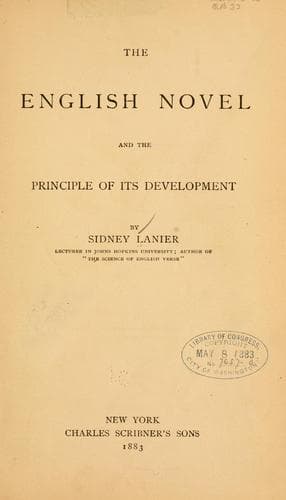
The English Novel and the Principle of its DevelopmentLanier, Sidney
History
The English Novel and the Principle of its Development
Lanier, Sidney
English fiction -- History and criticism
This is done under
pretext of showing us vice.
In fine, and this is the characterization I shall use in contrasting
this group with that much sweeter group led by George Eliot, the
distinctive feature of these first novelists is to show men with
microscopic detail how bad men may be. I shall presently illustrate
with the George Eliot group how much larger the mission of the novel
is than this; meantime, I cannot leave this matter without recording,
in the plainest terms, that, for far deeper reasons than those which
Roger Bacon gave for sweeping away the works of Aristotle, if I had my
way with these classic books I would blot them from the face of the
earth. One who studies the tortuous behaviors of men in history soon
ceases to wonder at any human inconsistency; but, so far as I _can_
marvel, I _do_ daily that we regulate by law the sale of gunpowder,
the storage of nitro-glycerine, the administration of poison--all of
which can hurt but our bodies--but are absolutely careless of these
things--so-called classic books, which wind their infinite
insidiousnesses about the souls of our young children, and either
strangle them or cover them with unremovable slime under our very
eyes, working in a security of fame and so-called classicism that is
more effectual for this purpose than the security of the dark. Of this
terror it is the sweetest souls who know most.
In the beginning of _Aurora Leigh_, Mrs. Browning speaks this matter
so well that I must clinch my opinion with her words. Aurora Leigh
says, recalling her own youthful experience:
"Sublimest danger, over which none weep,
When any young wayfaring soul goes forth
Alone, unconscious of the perilous road,
The day-sun dazzling in his limpid eyes,
To thrust his own way, he an alien, through
The world of books! Ah, you!--you think it fine,
You clap hands--'A fair day!'--you cheer him on
As if the worst could happen, were to rest
Too long beside a fountain. Yet behold,
Behold!--the world of books is still the world;
And worldlings in it are less merciful
And more puissant. For the wicked there
Are winged like angels. Every knife that strikes
Is edged from elemental fire to assail
Our spiritual life. The beautiful seems right
By force of beauty, and the feeble wrong
Because of weakness....
... In the book-world, true,
There's no lack, neither, of God's saints and kings...
True, many a prophet teaches in the roads ...
But stay--who judges?...
... The child there? Would you leave
That child to wander in a battle-field
And push his innocent smile against the guns?
Or even in the catacombs--his torch
Grown ragged in the fluttering air, and all
The dark a-mutter round him? not a child!"
Public-domain text, read in full here on John Shaqi.
Reviews
Reviews
No reviews yet
Be the first to share your thoughts on this work.
Elsewhere in the archive
Join the Discussion
Join the discussion
Sign in to leave a comment or review.
Sign InorCreate an account