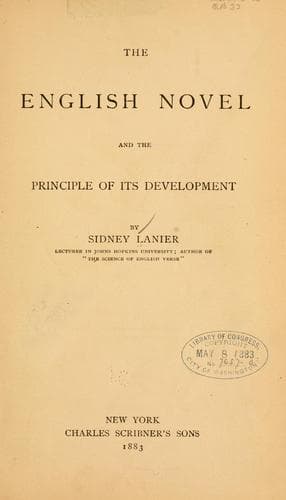
The English Novel and the Principle of its DevelopmentLanier, Sidney
History
The English Novel and the Principle of its Development
Lanier, Sidney
English fiction -- History and criticism
But I cannot help mentioning here a book which occurs during this
period, and which attaches itself by the oddest imaginable ties to
what was said in a previous lecture, of The Novel, as the true
meeting-ground where the poetic imagination and the scientific
imagination come together and incorporate themselves. Now, to make the
true novel--the work which takes all the miscellaneous products of
scientific observation and carries them up into a higher plane and
incarnates them into the characters (as we call them) of a book, and
makes them living flesh and blood like ourselves--to effect this,
there must be a true incorporation and merger of the scientific and
poetic faculties into one: it is not sufficient if they work side by
side like two horses abreast, they must work like a man and wife with
one soul; or to change the figure, their union must not be mechanical,
it must be chemical, producing a thing better than either alone; or
to change the figure again, the union must be like that which Browning
has noticed as existing among the ingredients of a musical chord,
when, as he says, out of three tones, we make not a fourth, but a
star.
Now the book I mean shows us the scientific faculty, and the poetic
faculty--and no weak faculties either--working along together, _not_
merged, _not_ chemically united, _not_ lighting up matter like a
star,--with the result, as seems to me, of producing the very drollest
earnest book in our language. It is _The Loves of the Plants_, by Dr.
Erasmus Darwin, grandfather, I believe, to our own grave and patient
Charles Darwin. _The Loves of the Plants_ is practically a series of
little novels in which the heroes and heroines belong to the vegetable
world. Linnæus had announced the sexuality of plants, and so had made
this idea a principle of classification, the one-stamen class,
_Monandria_, two stamen class, _Diandria_, etc., etc. Now all this the
diligent and truly loving Doctor framed into poetry, and poetry which
so far as technical execution goes is quite as good as the very best
of the Pope school which it follows. Here are a few specimens of the
poem:
"Descend, ye hovering sylphs! aërial quires,
And sweep with little hands your silver lyres;
With fairy footsteps print your grassy rings,
Ye Gnomes! accordant to the tinkling strings:
While in soft notes I tune to oaten reed
Gay hopes, and amorous sorrows of the mead;--
From giant Oaks, that wave their branches dark,
To the dwarf Moss that clings upon their bark,
What Beaux and Beauties crowd the gaudy groves,
And woo and win their vegetable Loves.
* * * * *
"First the tall Canna lifts his curled brow
Erect to heaven, and plights his nuptial vow;
The virtuous pair, in milder regions born,
Dread the rude blast of Autumn's icy morn;
Round the chill fair he folds his crimson vest,
And clasps the timorous beauty to his breast!"
Public-domain text, read in full here on John Shaqi.
Reviews
Reviews
No reviews yet
Be the first to share your thoughts on this work.
Elsewhere in the archive
Join the Discussion
Join the discussion
Sign in to leave a comment or review.
Sign InorCreate an account