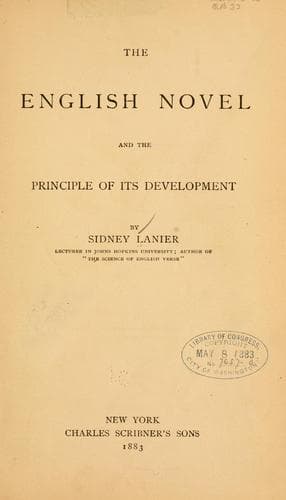
The English Novel and the Principle of its DevelopmentLanier, Sidney
History
The English Novel and the Principle of its Development
Lanier, Sidney
English fiction -- History and criticism
Here, however, a serious case presents itself; in _Canna_ there was
one stamen to one pistil, and this was comfortable; but in the next
flower he happened to reach--the _Genista_ or Wild Broom--there were
ten stamens to one pistil; that is, ten lovers to one lady; but the
intrepid Doctor carries it through, all the same, managing the whole
point simply by airy swiftness of treatment:
"Sweet blooms Genista[A] in the myrtle shade,
And ten fond brothers woo the haughty maid."
But sometimes our botanist comes within a mere ace of beautiful
poetry, as for example:
"When o'er the cultured lawns and dreary wastes,
Retiring Autumn flings her howling blasts,
Bends in tumultuous waves the struggling woods,
And showers their leafy honors on the floods;
In withering heaps collects the flowery spoil;
And each chill insect sinks beneath the soil:
Quick flies fair Tulipa the loud alarms,
And folds her infant closer in her arms;
In some lone cave, secure pavilion, lies,
And waits the courtship of serener skies."
This book has what it calls Interludes between the parts, in which the
Bookseller and the Poet discuss various points arising in it; and its
oddity is all the more increased when one finds here a number of the
most just, incisive, right-minded and large views not only upon the
mechanism of poetry, but upon its essence and its relations to other
arts.[B]
[Footnote A: Genista, or _Planta Genista_, origin of "Plantagenet,"
from the original name-giver's habit of wearing a tuft of his native
heath or broom in his bonnet.]
[Footnote B: Carlyle's opinion of the book is given with a comical
grimness in his Reminiscences _à propos_ of the younger Erasmus
Darwin, who used much to visit the Carlyles after they settled in
London: "Erasmus Darwin, a most diverse kind of mortal, came to seek
us out very soon ('had heard of Carlyle in Germany,' &c.), and
continues ever since to be a quiet home-friend, honestly attached;
though his visits latterly have been rarer and rarer, health so poor,
I so occupied, etc., etc. He had something of original and
sarcastically ingenious in him; one of the sincerest, naturally
honest, and most modest of men; elder brother of Charles Darwin (the
famed Darwin on Species of these days), to whom I rather prefer him
for intellect, had not his health quite doomed him to silence and
patient idleness--grandsons, both, of the first famed Erasmus
('Botanic Garden,' etc.), who also seems to have gone upon 'species'
questions, '_omnia ex conchis_' (all from oysters), being a dictum of
his (even a stamp he sealed with still extant), as this present
Erasmus once told me, many long years before this of Darwin on Species
came up among us. Wonderful to me, as indicating the capricious
stupidity of mankind: never could read a page of it, or waste the
least thought upon it."]
Public-domain text, read in full here on John Shaqi.
Reviews
Reviews
No reviews yet
Be the first to share your thoughts on this work.
Elsewhere in the archive
Join the Discussion
Join the discussion
Sign in to leave a comment or review.
Sign InorCreate an account