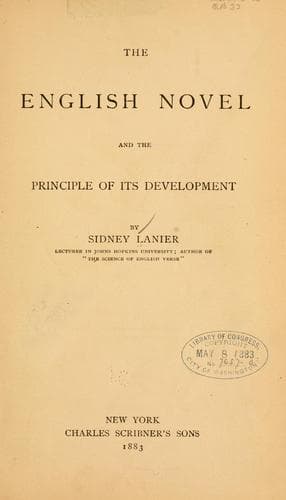
The English Novel and the Principle of its DevelopmentLanier, Sidney
History
The English Novel and the Principle of its Development
Lanier, Sidney
English fiction -- History and criticism
I think all reasoning and experience show that if you confront a man
day by day with nothing but a picture of his own unworthiness, the
final effect is, not to stimulate, but to paralyze his moral energy.
The picture of the man becomes the head of a Gorgon. Now this was
precisely what this early English fiction professed to do. It
professed to show man exactly as he is; but although this profession
included the good man as well as the bad man, and although there was
some endeavor to relieve the picture with tints of goodness here and
there, the final result was--and I fearlessly point any doubter to the
net outcome from _Pamela_ and _Clarissa Harlowe_ down to _Humphrey
Clinker_--the final result was such a portrayal as must make any man
sit down before the picture in a miserable deep of contempt for
himself and his fellows, out of which many spirits cannot climb at
all, and none can climb clean.
On the other hand, the work of Dickens I have just referred to is a
fair specimen of the way in which the later school of English fiction,
while glozing no evil, showed man, not how bad he might be, but how
good he might be; and thus, instead of paralyzing the moral energy,
stimulated it to the most beneficent practical reform. I think it is
Robert Browning who has declared that a man is as good as his best;
and there is the subtlest connection between the right to measure a
man's moral stature by the highest thing that he has done, rather than
the lowest, on the one hand, and that new and beautiful inspiration
which comes into one's life as one contemplates more and more
instances of the best in human behavior, as these are given by a
literature which thus lifts one up from day to day with the
declaration that however commonplace a man may be, he yet has within
himself the highest capabilities of what we have agreed to call the
russet-coated epic. The George Eliot and Dickens school, in fact, do
but expand the text of the Master when He urges His disciples: "Be ye
perfect as I am perfect."
Let me now suggest a second difference between the two schools which
involves an interesting coincidence and now specially concerns us. As
between Richardson and Fielding, it has been well said (by whom I
cannot now remember) that Fielding tells you the time of day, whilst
Richardson shows you how the watch is made. As indicating Fielding's
method of conducting the action rather by concrete dialogue and event,
than by those long analytic discussions of character in which
Richardson would fill whole pages with minute descriptions of the
changing emotions of Clarissa upon reading a certain letter from
Lovelace, pursuing the emotion as it were tear by tear,
_lachrymatim_,--this characterization happily enough contrasts the
analytic strength of Richardson with the synthetic strength of
Fielding.
Public-domain text, read in full here on John Shaqi.
Reviews
Reviews
No reviews yet
Be the first to share your thoughts on this work.
Elsewhere in the archive
Join the Discussion
Join the discussion
Sign in to leave a comment or review.
Sign InorCreate an account