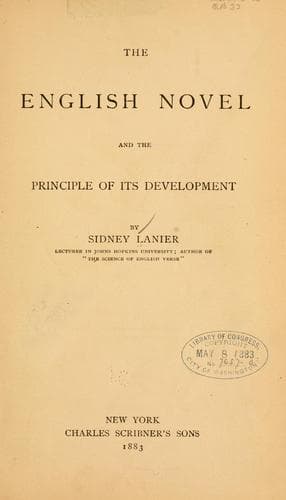
The English Novel and the Principle of its DevelopmentLanier, Sidney
History
The English Novel and the Principle of its Development
Lanier, Sidney
English fiction -- History and criticism
This publication of _Adam Bede_, placed George Eliot decisively at the
head of English novel-writers, with only Dickens for second, even; and
thus enables us at this point fairly to do what the ages always do in
order to get that notoriously clear view of things which comes with
time, and time only, that is to brush away all small circumstances and
cloudy non-essentials of time so as to bring before our minds the
whole course of English fiction, from its beginning to the stage at
which it is now pending with _Adam Bede_, as if it concerned but four
names and two periods, to wit:
RICHARDSON, } middle 18th century
FIELDING. }
and
DICKENS, } middle 19th century.
GEORGE ELIOT. }
Now it was shown in the last lecture how distinctly the moral purpose
of the English fiction represented by this upper group was announced,
though we were obliged to record a mournful failure in realizing that
announcement. _Adam Bede_ gives us the firmest support for a first and
most notable difference between these two periods of English fiction,
that while the former professes morality yet fails beyond description,
the latter executes its moral purpose to a practical degree of
beneficence beyond its wildest hopes. Without now specifying the
subtle revolutions which lie in _Adam Bede_, a single more tangible
example will be sufficient to bring this entire difference before you.
If I ask you to recall how it is less than fifty years ago that
Charles Dickens was writing of the debtors' prisons with all the
terrible earnest of one who had lived with his own father and mother
in those unspeakable dens; if I recall to you what marvelous haste for
proverbially slow England the reform thus initiated took upon itself,
how it flew from this to that prison, from this to that statute, from
this to that country, until now not only is no such thing as
imprisonment for debt known to any of Dickens's readers, but with the
customary momentum of such generous impulses in society, the whole
movement in favor of debtors is clearly going too far and is beginning
to oppress the creditor with part of the injustice it formerly meted
out to the debtor; if, I say, I thus briefly recall to you this single
instance of moral purpose carried into perfect practice, I typify a
great and characteristic distinction between these two schools. For in
point of fact what one may call an organic impracticability lay at the
core of the moral scheme of Richardson and Fielding.
Public-domain text, read in full here on John Shaqi.
Reviews
Reviews
No reviews yet
Be the first to share your thoughts on this work.
Elsewhere in the archive
Join the Discussion
Join the discussion
Sign in to leave a comment or review.
Sign InorCreate an account