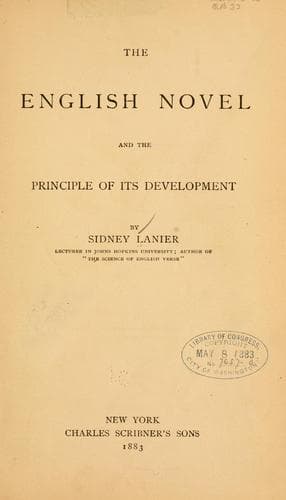
The English Novel and the Principle of its DevelopmentLanier, Sidney
History
The English Novel and the Principle of its Development
Lanier, Sidney
English fiction -- History and criticism
diagrams, plans, elevations and sections, but alas! no picture. Mine,
I fear is not a well-regulated mind: it has an occasional tenderness
for old abuses; it lingers with a certain fondness over the days of
nasal clerks and top-booted parsons, and has a sigh for the departed
shades of vulgar errors." And it is worth while, if even for an aside,
to notice in the same passage how this immense projection of herself
out of herself into what we may fairly call her antipodes, is not only
a matter of no strain, but from the very beginning is accompanied by
that eye-twinkle between the lines which makes much of the very
ruggedest writing of George Eliot's like a Virginia fence from between
whose rails peep wild roses and morning-glories.
This is in the next paragraph where after thus recalling the outside
of Shepperton church, she exclaims: "Then inside what dear old
quaintnesses! which I began to look at with delight even when I was so
crude a member of the congregation that my nurse found it necessary to
provide for the reinforcement of my devotional patience by smuggling
bread and butter into the sacred edifice." Or, a few lines before, a
still more characteristic twinkle of the eye which in a flash carries
our thoughts all the way from evolution to pure fun, when she
describes the organ-player of the new Shepperton church as a
rent-collector "differentiated by force of circumstances into an
organist." Apropos of this use of the current scientific term
"differentiation," it is worth while noting, as we pass, an instance
of the extreme vagueness and caprice of current modern criticism.
When George Eliot's _Daniel Deronda_ was printed in 1876, one of the
most complacent English reviews criticized her expression "dynamic
power of" a woman's glance, which occurs in her first picture of
Gwendolen Harleth, as an inappropriate use of scientific phraseology;
and was immediately followed by a chorus of small voices discussing
the matter with much minute learning, rather as evidence of George
Eliot's decline from the proper artistic style. But here, as you have
just seen, in the very first chapter of her first story, written
twenty years before, scientific "differentiation" is made to work very
effectively; and a few pages further on we have an even more striking
instance in this passage: "This allusion to brandy-and-water suggested
to Miss Gibbs the introduction of the liquor decanters now that the
tea was cleared away; for in bucolic society five-and-twenty-years
ago, the human animal of the male sex was understood to be perpetually
athirst, and 'something to drink' was as necessary a 'condition of
thought' as Time and Space." Other such happy uses of scientific
phrases occur indeed throughout the whole of these first three
stories, and form an integral part of that ever-brooding humor which
fills with a quiet light all the darkest stories of George Eliot.
Public-domain text, read in full here on John Shaqi.
Reviews
Reviews
No reviews yet
Be the first to share your thoughts on this work.
Elsewhere in the archive
Join the Discussion
Join the discussion
Sign in to leave a comment or review.
Sign InorCreate an account