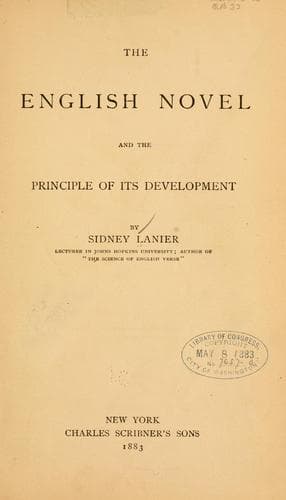
The English Novel and the Principle of its DevelopmentLanier, Sidney
History
The English Novel and the Principle of its Development
Lanier, Sidney
English fiction -- History and criticism
But now, on the other hand, it is in strong contrast that we find her
co-laborer Dickens, always growing furious (as his biographer
describes), when the ante-reform days are mentioned, those days of
rotten boroughs, etc., when, as Lord John Russell said, "a ruined
mound sent two representatives to Parliament, three niches in a stone
wall sent three representatives to parliament, and a park where no
houses were to be seen sent two representatives to Parliament." While
George Eliot is indulging in the tender recollections of
picturesqueness, etc., just given, Dickens is writing savage versions
of the old ballad, _The Fine Old English Gentleman_, in which he
fiercely satirizes the old Tory England:
"I will sing you a new ballad" (he cries), "and I'll warrant it
first-rate,
Of the days of that old gentleman who had that old estate,
The good old laws were garnished well with gibbets, whips and chains,
With fine old English penalties and fine old English pains;
With rebel heads and seas of blood once hot in rebel veins:
For all these things were requisite to guard the rich old gains
Of the fine old English Tory times;
Soon may they come again!
The good old times for cutting throats that cried out in their need,
The good old times for hunting men who held their father's creed,
The good old times when William Pitt, as all good men agreed,
Came down direct from Paradise at more than railroad speed;
Oh, the fine old English Tory times,
When will they come again!
In those rare days the press was seldom known to snarl or bark,
But sweetly sang of men in power like any tuneful lark;
Grave judges, too, to all their evil deeds were in the dark;
And not a man in twenty score knew how to make his mark.
Oh, the fine old English Tory times,
Soon may they come again!"
In a word, the difference between Dickens' and George Eliot's powers
is here typified: Dickens tends toward the satiric or destructive view
of the old times; George Eliot, with an even more burning intolerance
of the essential evil, takes, on the other hand, the loving or
constructive view. It is for this reason that George Eliot's work, as
a whole, is so much finer than some of Dickens'. The great artist
never can work in haste, never in malice, never in even the sub-acid
satiric mood of Thackeray; in love, and love only, can great work,
work that not only pulls down, but builds, be done; it is love, and
love only, that is truly constructive in art.
Public-domain text, read in full here on John Shaqi.
Reviews
Reviews
No reviews yet
Be the first to share your thoughts on this work.
Elsewhere in the archive
Join the Discussion
Join the discussion
Sign in to leave a comment or review.
Sign InorCreate an account