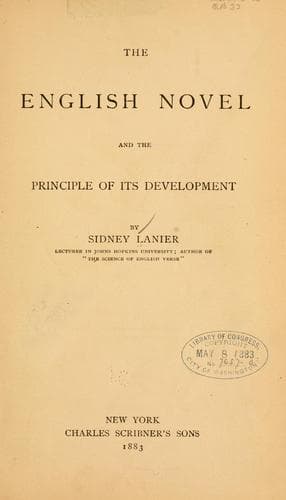
The English Novel and the Principle of its DevelopmentLanier, Sidney
History
The English Novel and the Principle of its Development
Lanier, Sidney
English fiction -- History and criticism
All the world knows how Dickens puts a personality on his canvas: he always
gives us a vividly descriptive line of facial curve, of dress, of form, of
gesture and the like, which distinguishes a given character. Whenever we
see this line we know the character so well that we are perfectly content
that two rings for the eyes, a spot for the nose and a blur for the body
may represent the rest; and we accept always with joy the rich mirthfulness
or pathetic matter with which Dickens manages to invest such hastily drawn
figures. George Eliot's principle and method are completely opposite; at
the time of her first stories which we are now considering they were
unique; and the quietness with which she made a real epoch in all
character-description is simply characteristic of the quietness of all her
work. She showed for the first time that without approaching dangerously
near to caricature as Dickens was often obliged to do, a loveable creature
of actual flesh and blood could be drawn in a novel with all the advantage
of completeness derivable from microscopic analysis, scientific precision,
and moral intent; and with absolutely none of the disadvantages, such as
coldness, deadness and the like, which had caused all sorts of
meretricious arts to be adopted by novelists in order to save the
naturalness of a character.
A couple of brief expressions from _Janet's Repentance_, the third of
_Scenes from Clerical Life_ show how intensely George Eliot felt upon
this matter. At the end of Chapter X of that remarkable story, for
instance, she says: "Our subtlest analysis of schools and sects must
miss the essential truth unless it be lit up by the love that sees in
all forms of human thought and work the life-and-death struggles of
separate human beings." And again in Chapter XXII: "Emotion, I fear,
is obstinately irrational: it insists on caring for individuals; it
absolutely refuses to adopt the quantitative view of human anguish,
and to admit that thirteen happy lives are a set-off against twelve
miserable lives," leaving "a clear balance on the side of
satisfaction.... One must be a great philosopher," she adds,
sardonically, "to have emerged into the serene air of pure intellect
in which it is evident that individuals really exist for no other
purpose than that abstractions may be drawn from them:" (which is
dangerously near, by the way, to a complete formula of the Emersonian
doctrine which I had occasion to quote in my last lecture.) She
continues: "And so it comes to pass that for the man who knows
sympathy because he has known sorrow, that old, old saying, about the
joy of angels over the repentant sinner out-weighing their joy over
the ninety-nine just, has a meaning that does not jar with the
language of his own heart. It only tells him that for angels too there
is a transcendent value in human pain which refuses to be settled by
equations; ... that for angels too the misery of one casts so
Public-domain text, read in full here on John Shaqi.
Reviews
Reviews
No reviews yet
Be the first to share your thoughts on this work.
Elsewhere in the archive
Join the Discussion
Join the discussion
Sign in to leave a comment or review.
Sign InorCreate an account