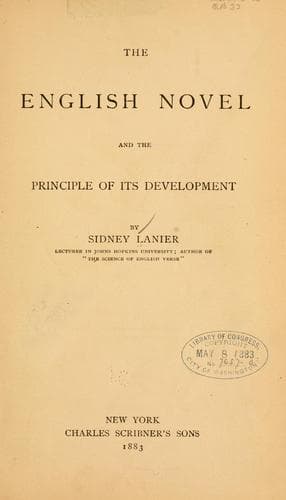
The English Novel and the Principle of its DevelopmentLanier, Sidney
History
The English Novel and the Principle of its Development
Lanier, Sidney
English fiction -- History and criticism
to find a woman, George Eliot, departing utterly out of that mood of
hate or even of acidulous satire in which Thackeray so often worked,
and in which, one may add, the world is seldom benefited, however
skillful the work may be, departing from all that, deftly painting for
us these pathetic Milly Bartons, and Mr. Gilfils, and Janet Dempsters,
and Rev. Tryans, and arranging the whole into a picture which becomes
epic because it is filled with the struggles of human personalities,
dressed in whatever russet garb of clothing or of circumstances.
Those who were at my first lecture on George Eliot will remember that
we found the editor of _Blackwood's Magazine_ on a certain autumn
night in 1856, reading part of the MS. of _Amos Barton_, in his
drawing-room to Thackeray, and remarking to Thackeray, who had just
come in late from dinner, that he had come upon a new author who
seemed uncommonly like a first-class passenger; it is significantly
related that Thackeray said nothing, and evinced no further interest
in it than civilly to say, sometime afterward, that he would have
liked to hear more of it. In the light of the contrast I have just
drawn, Thackeray's failure to be impressed seems natural enough, and
becomes indeed all the more impressive, when we compare it with the
enthusiastic praise which Charles Dickens lavished upon this same work
in the letter which you will remember I read from him.
And here I come upon a further contrast between George Eliot and
Dickens which I should be glad now to bring out as clearly appearing
in these first three _Scenes from Clerical Life_ before _Adam Bede_ was
written.
This is her exquisite modernness in that intense feeling for
personality, which I developed with so much care in my first six
lectures, and her exquisite scientific precision in placing the
personalities or characters of her works before the reader.
Public-domain text, read in full here on John Shaqi.
Reviews
Reviews
No reviews yet
Be the first to share your thoughts on this work.
Elsewhere in the archive
Join the Discussion
Join the discussion
Sign in to leave a comment or review.
Sign InorCreate an account