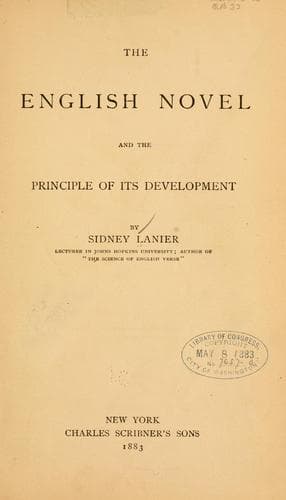
The English Novel and the Principle of its DevelopmentLanier, Sidney
History
The English Novel and the Principle of its Development
Lanier, Sidney
English fiction -- History and criticism
This story of _Janet's Repentance_ offers us, by the way, a strong
note of modernness as between George Eliot and Shakspeare. Shakspeare
has never drawn, so far as I know, a repentance of any sort. Surely,
in the whole range of our life, no phenomenon can take more powerful
hold upon the attention of the thinker than that of a human spirit
suddenly, of its own free-will, turning the whole current of its love
and desire from a certain direction into a direction entirely
opposite; so that from a small spiteful creature, enamored with all
ugliness, we have a large, generous spirit, filled with the love of
true love. In looking upon such a sight one seems to be startlingly
near to the essential mystery of personality--to that hidden fountain
of power not preceded, power not conditioned, which probably gives man
his only real conception of Divine power, or power acting for itself.
It would be wonderful that the subtleties of human passion
comprehended in the situation of repentance had not attracted
Shakspeare's imagination, if one did not remember that the developing
personality of man was then only coming into literature. The only
apparent change of character of this sort in Shakspeare which I
recall is that of the young king Henry V. leaving Falstaff and his
other gross companions for the steadier matters of war and government;
but the soliloquy of Prince Hal in the very first act of King Henry
IV. precludes all idea of repentance here, by showing that at the
outset his heart is not in the jolly pranks, but that he is
calculatingly ambitious from the beginning; and his whole apparent
dissipation is but a scheme to enhance his future glory. In the first
act of Henry IV. (first part), when the plot is made to rob the
carriers, at the end of Scene II., _exeunt_ all but Prince Hal, who
soliloquizes thus:
"I know you all, and will awhile uphold
The unyoked humor of your idleness:
Yet herein will I imitate the sun,
Who doth permit the base contagious clouds
To smother up his beauty from the world,
That, when he please again to be himself,
Being wanted, he may be more wondered at
By breaking through the foul and ugly mists
Of vapors that did seem to strangle him.
... So when this loose behaviour I throw off
And pay the debt I never promised,
By how much better than my word I am,
By so much shall I falsify men's hopes;
And, like bright metal on a sullen ground,
My reformation, glittering o'er my fault,
Shall show more goodly and attract more eyes
Than that which had no foil to set it off.
I'll so offend to make offense a skill,
Redeeming time when men think least I will."
Here the stream of his love is from the beginning and always towards
ambition; there is never any turn at all, and Prince Hal's assumption
of the grace _reformation_, as applied to such a career of deliberate
acting, is merely a piece of naïve complacency.
Public-domain text, read in full here on John Shaqi.
Reviews
Reviews
No reviews yet
Be the first to share your thoughts on this work.
Elsewhere in the archive
Join the Discussion
Join the discussion
Sign in to leave a comment or review.
Sign InorCreate an account