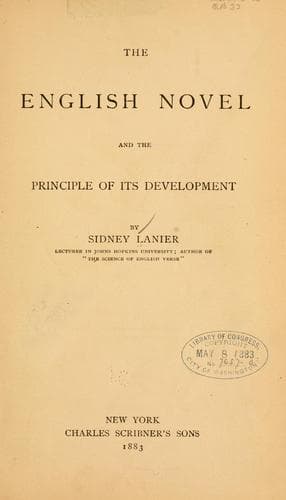
The English Novel and the Principle of its DevelopmentLanier, Sidney
History
The English Novel and the Principle of its Development
Lanier, Sidney
English fiction -- History and criticism
Let us now go further and say that with this reverence for personality
as to the ultimate important fact of human existence, George Eliot
wonderfully escapes certain complexities due to the difference between
what a man is, really, and what he seems to be to his fellows. Perhaps
I may most easily specify these complexities by asking you to recall
the scene in one of Dr. Holmes' _Breakfast-Table_ series, where the
Professor laboriously expounds to the young man called John that there
are really three of him, to wit: John, as he appears to his neighbors;
John, as he appears to himself; and John, as he really is.
In George Eliot's _Theophrastus Such_, one finds explicit mention of
the trouble that had been caused to her by two of these: "With all
possible study of myself," she says in the first chapter ... "I am
obliged to recognize that while there are secrets in one unguessed by
others, these others have certain items of knowledge about the extent
of my powers and the figure I make with them which, in turn, are
secrets unguessed by me.... Thus ... O fellow-men! if I trace with
curious interest your labyrinthine self-delusions ... it is not that I
feel myself aloof from you: the more intimately I seem to discern your
weaknesses the stronger to me is the proof I share them.... No man can
know his brother simply as a spectator. Dear blunderers, I am one of
you."
Perhaps nothing less than this underlying reverence for all manner of
personality could have produced this first chapter of _Adam Bede_.
"With this drop of ink," she says at starting, "I will show you the
roomy work-shop of Mr. Jonathan Burge, carpenter and builder in the
village of Hayslope, as it appeared on the 18th of June, in the year
of our Lord 1799." I can never read this opening of the famous
carpenter's shop without indulging myself for a moment in the wish
that this same marvellous eye might have dwelt upon a certain
carpenter's shop I wot of, on some 18th of June, in the year of our
Lord 25. What would we not give for such a picture of the work-shop of
that master-builder and of the central figure in it as is here given
us of the old English room ringing with the song of _Adam Bede_.
Perhaps we could come upon no clearer proof of that modernness of
personality which I have been advocating than this very fact of our
complete ignorance as to the physical person of Christ. One asks one's
self, how comes it never to have occurred to St. Matthew, nor St.
Mark, nor St. Luke, nor St. John to tell us what manner of man this
was--what stature, what complexion, what color of eye and hair, what
shape of hand and foot. A natural instinct arising at the very outset
of the descriptive effort would have caused a modern to acquaint us
with these and many like particulars.
Public-domain text, read in full here on John Shaqi.
Reviews
Reviews
No reviews yet
Be the first to share your thoughts on this work.
Elsewhere in the archive
Join the Discussion
Join the discussion
Sign in to leave a comment or review.
Sign InorCreate an account