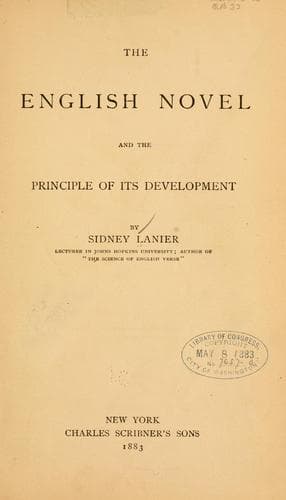
The English Novel and the Principle of its DevelopmentLanier, Sidney
History
The English Novel and the Principle of its Development
Lanier, Sidney
English fiction -- History and criticism
"Another morning, what was wholesome and better, happening to notice,
as I stood looking out on the bit of green under my bedroom window, a
trim and rather pretty hen actively paddling about and picking up what
food might be discoverable, 'See,' I said to myself; "look, thou fool!
Here is a two-legged creature with scarcely half a thimbleful of poor
brains; thou call'st thyself a man with nobody knows how much brain,
and reason dwelling in it; and behold how the one _life_ is regulated
and how the other! In God's name concentrate, collect whatever of
reason thou hast, and direct it on the one thing needful.' Irving,
when we did get into intimate dialogue, was affectionate to me as
ever, and had always to the end a great deal of sense and insight
into things about him, but he could not much help me; how could
anybody but myself? By degrees I was doing so, taking counsel of that
_symbolic_ Hen."
In George Eliot all the domestic animals are true neighbors and are
brought within the Master's exhortation: "Thou shalt love thy neighbor
as thyself," by the tenderness and deep humor with which she treats
them. This same Gyp, who is honored with first place among the
characters described in the carpenter's shop, is continually doing
something charming throughout _Adam Bede_. In _Janet's Repentance_
dear old Mr. Jerome comes down the road on his roan mare, "shaking the
bridle and tickling her flank with the whip as usual, though there was
a perfect mutual understanding that she was not to quicken her pace;"
and everywhere I find those touches of true sympathy with the dumb
brutes, such as only earnest souls or great geniuses are capable of.
Somehow--I cannot now remember how--a picture was fastened upon my
mind in childhood, which I always recall with pleasure: it is the
figure of man emerging from the dark of barbarism attended by his
friends the horse, the cow, the chicken and the dog. George Eliot's
animal-painting brings always this picture before me.
Public-domain text, read in full here on John Shaqi.
Reviews
Reviews
No reviews yet
Be the first to share your thoughts on this work.
Elsewhere in the archive
Join the Discussion
Join the discussion
Sign in to leave a comment or review.
Sign InorCreate an account