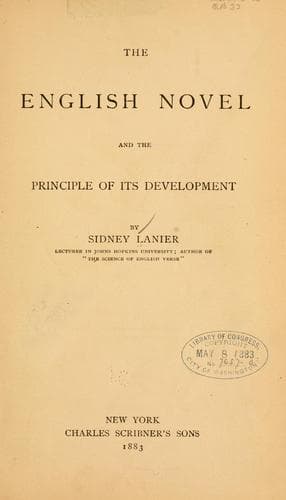
The English Novel and the Principle of its DevelopmentLanier, Sidney
History
The English Novel and the Principle of its Development
Lanier, Sidney
English fiction -- History and criticism
In April, 1860, appeared George Eliot's second great novel, _The Mill
on the Floss_. This book, in some respects otherwise her greatest
work, possesses a quite extraordinary interest for us now in the
circumstance that a large number of traits in the description of the
heroine, Maggie Tulliver, are unquestionably traits of George Eliot
herself, and the autobiographic character of the book has been avowed
by her best friends. I propose, therefore, in the next lecture, to
read some passages from _The Mill on the Floss_, in which I may have
the pleasure of letting this great soul speak for herself with little
comment from me, except that I wish to compare the figure of Maggie
Tulliver, specially, with that of Aurora Leigh, in the light of the
remarkable development of womanhood, both in real life and in fiction,
which arrays itself before us when we think only of what we may call
the Victorian women; that is, of the queen herself, Sister Dora,
Florence Nightingale, Ida in Tennyson's _Princess_, Jane Eyre,
Charlotte Bronte and her sisters, Mrs. Browning, with her Eve and
Catarina and Aurora Leigh, and George Eliot, with her creations. I
shall thus make a much more extensive study of _The Mill on the Floss_
than of either of the four works which preceded it. It is hard to
leave Adam Bede, and Dinah Morris and Bartle Massey, and Mrs. Poyser,
but I must select; and I have thought this particularly profitable
because no criticism that I have yet seen of George Eliot does the
least justice to the enormous, the simply unique equipment with which
she comes into English fiction, or in the least prepares the reader
for those extraordinary revolutions which she has wrought with such
demure quietness that unless pointed out by some diligent professional
student, no ordinary observer would be apt to notice them. Above all
have I done this because it is my deep conviction that we can find
more religion in George Eliot's words than she herself dreamed she was
putting there, and a clearer faith for us than she ever formulated for
herself; a strange and solemn result, but one not without parallel;
for Mrs. Browning's words of Lucretius in _The Vision of Poets_ partly
apply here:
"Lucretius, nobler than his mood!
Who dropped his plummet down the broad
Deep Universe, and said 'No God',
Finding no bottom! He denied
Divinely the divine, and died
Chief-poet on the Tiber-side
By grace of God! His face is stern
As one compelled, in spite of scorn,
To teach a truth he could not learn."
X.
Public-domain text, read in full here on John Shaqi.
Reviews
Reviews
No reviews yet
Be the first to share your thoughts on this work.
Elsewhere in the archive
Join the Discussion
Join the discussion
Sign in to leave a comment or review.
Sign InorCreate an account