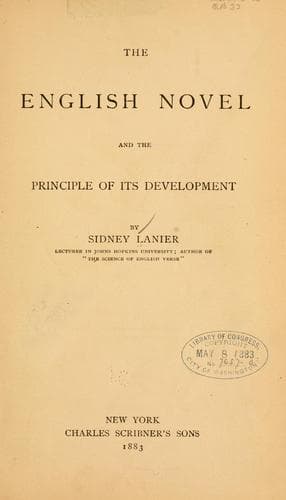
The English Novel and the Principle of its DevelopmentLanier, Sidney
History
The English Novel and the Principle of its Development
Lanier, Sidney
English fiction -- History and criticism
While it is true that the publication of _Adam Bede_ enables us--as
stated in the last lecture--to fix George Eliot as already at the head
of English novel writers in 1859, I should add that the effect of the
book was not so well defined upon the public of that day. The work was
not an immediate popular success; and even some of the authoritative
critics, instead of recognizing its greatness with generosity, went
pottering about to find what existing authors this new one had most
likely drawn her inspiration from.
But _The Mill on the Floss_, which appeared in April, 1860, together
with some strong and generous reviews of _Adam Bede_, which had
meantime appeared in _Blackwood's Magazine_ and in the _London Times_,
quickly carried away the last vestige of this suspense, and _The Mill
on the Floss_ presently won for itself a popular audience and loving
appreciation which appear to have been very gratifying to George Eliot
herself. This circumstance alone would make the book an interesting
one for our present special study; but the interest is greatly
heightened by the fact--a fact which I find most positively stated by
those who most intimately knew her--that the picture of girlhood which
occupies so large a portion of the first part of the book, is, in many
particulars, autobiographic. The title originally chosen for this work
by George Eliot was _Sister Maggie_, from which we may judge the
prominence she intended to give to the character of Maggie Tulliver.
After the book was finished, however, this title was felt to be, for
several reasons, insufficient. It was a happy thought of Mr.
Blackwood's to call the book _The Mill on the Floss_; and George Eliot
immediately adopted his suggestion to that effect. There is, too, a
third reason why this particular work offers some peculiar
contributions to the main lines of thought upon which these lectures
have been built. As I go on to read a page here and there merely by
way of recalling the book and the actual style to you, you will
presently find that the interest of the whole has for the time
concentrated itself upon the single figure of a little wayward English
girl some nine years old, perhaps alone in a garret in some fit of
childish passion, accusing the Divine order of things as to its
justice or mercy, crudely and inarticulately enough yet quite as
keenly after all as our _Prometheus_, either according to Æschylus or
Shelley. As I pass along rapidly bringing back to you these pictures
of Maggie's girlish despairs, I beg you to recall the first scenes
which were set before you from the _Prometheus_, to bear those in mind
along with these, to note how Æschylus--whom we have agreed to
consider as a literary prototype, occupying much the same relation to
his age as George Eliot does to ours--in stretching _Prometheus_ upon
the bare Caucasian rock and lacerating him with the just lightnings of
outraged Fate, is at bottom only studying with a ruder apparatus the
Public-domain text, read in full here on John Shaqi.
Reviews
Reviews
No reviews yet
Be the first to share your thoughts on this work.
Elsewhere in the archive
Join the Discussion
Join the discussion
Sign in to leave a comment or review.
Sign InorCreate an account