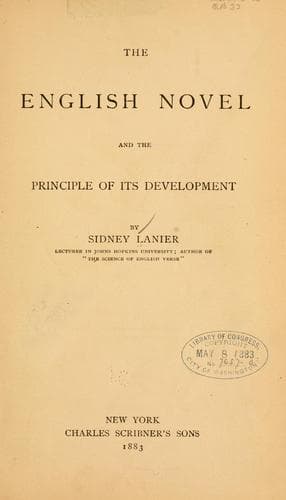
The English Novel and the Principle of its DevelopmentLanier, Sidney
History
The English Novel and the Principle of its Development
Lanier, Sidney
English fiction -- History and criticism
'I see you are one of the best!' laughed Winterbourne.
'Are you an American man?' pursued this vivacious infant. And
then on Winterbourne's affirmative reply,--'American men are the
best,' he declared."
On the other hand compare this intense, dark-eyed Maggie in her garret
and with her flaming ways, with Mrs. Browning's "Aurora Leigh." Aurora
Leigh, too, has her garret, and doubtless her intensity too, blossoms
in that congenial dark and lonesomeness. I read a few lines from Book
1st by way of reminder.
"Books, books, books!
I had found the secret of a garret-room
Piled high with cases in my father's name
... Where, creeping in and out
Among the giant fossils of my past
Like some small nimble mouse between the ribs
Of a mastodon, I nibbled here or there
At this or that box, pulling through the gap
In heats of terror, haste, victorious joy,
The first book first. And how I felt it beat
Under my pillow in the morning's dark,
An hour before the sun would let me read!
My books! At last, because the time was ripe,
I chanced upon the poets."
And here, every reader of _The Mill on the Floss_ will remember how,
at a later period, Maggie chanced upon Thomas à Kempis at a tragic
moment of her existence; and it is fine to see how in describing
situations so alike, the purely elemental differences between the
natures of Mrs. Browning and George Eliot project themselves upon each
other.
The scene in George Eliot concerning Maggie and Thomas à Kempis is too
long to repeat here, but everyone will recall the sober, analytic, yet
altogether vital and thrilling picture of the trembling Maggie, as she
absorbs wisdom from the sweet old mediæval soul. But, on the other
hand, Mrs. Browning sings it out, after this riotous melody:
"As the earth
Plunges in fury when the internal fires
Have reached and pricked her heart,
And throwing flat
The marts and temples--the triumphal gates
And towers of observation--clears herself
To elemental freedom--thus, my soul,
At poetry's divine first finger-touch,
Let go conventions and sprang up surprised,
Convicted of the great eternities
Before two worlds.
But the sun was high
When first I felt my pulses set themselves
For concord; when the rhythmic turbulence
Of blood and brain swept outward upon words,
As wind upon the alders, blanching them
By turning up their under-natures till
They trembled in dilation. O delight
And triumph of the poet who would say
A man's mere 'yes,' a woman's common 'no,'
A little human hope of that or this,
And says the word so that it burns you through
With special revelation, shakes the heart
Of all the men and women in the world
As if one came back from the dead and spoke,
With eyes too happy, a familiar thing
Become divine i' the utterance!"
Public-domain text, read in full here on John Shaqi.
Reviews
Reviews
No reviews yet
Be the first to share your thoughts on this work.
Elsewhere in the archive
Join the Discussion
Join the discussion
Sign in to leave a comment or review.
Sign InorCreate an account