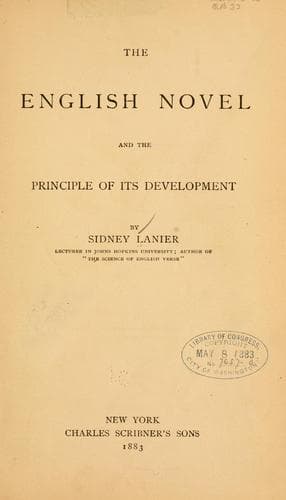
The English Novel and the Principle of its DevelopmentLanier, Sidney
History
The English Novel and the Principle of its Development
Lanier, Sidney
English fiction -- History and criticism
I have taken special pleasure in the last sentence of this outburst,
because it restates with a precise felicity at once poetic and
scientific, but from a curiously different point of view, that
peculiar function of George Eliot which I pointed out as appearing in
the very first of her stories, namely, the function of elevating the
plane of all commonplace life into the plane of the heroic by keeping
every man well in mind of the awful _ego_ within him which includes
all the possibilities of heroic action. Now this is what George Eliot
does, in putting before us these humble forms of Tom and Maggie, and
the like: she _says_ these common "yes" and "no" in terms of Tom and
Maggie; and yet says them so that this particular Tom and Maggie burn
you through with a special revelation--though one has known a hundred
Maggies and Toms before. Thus we find the delight and triumph of the
poetic and analytic novelist, George Eliot, precisely parallel to this
delight and triumph of the more exclusively poetic Mrs. Browning, who
says a man's mere "yes," a woman's common "no," so that it shakes the
hearts of all the men and women in the world, etc. Aurora Leigh
continues:
"In those days, though, I never analysed,
Not even myself, Analysis comes late.
You catch a sight of nature, earliest;
In full front sun-face, and your eye-lids wink
And drop before the wonder of 't; you miss
The form, through seeing the light. I lived those days,
And wrote because I lived--unlicensed else;
My heart beat in my brain. Life's violent flood
Abolished bounds--and, which my neighbor's field,
Which mine, what mattered? It is thus in youth!
We play at leap-frog over the god Time;
The love within us and the love without
Are mixed, confounded; if we are loved or love
We scarce distinguish....
In that first outrush of life's chariot wheels
We know not if the forests move, or we."
And now as showing the extreme range of George Eliot's genius, in
regions where perhaps Mrs. Browning never penetrated, let me recall
Sister Glegg and Sister Pullet, as types of women contrasting with
Maggie and Aurora Leigh. You will remember how Mrs. Tulliver has
bidden her three sisters, Mrs. Glegg, Mrs. Pullet, and Mrs. Deane,
with their respective husbands, to a great and typical Dodson dinner,
in order to eat and drink upon the momentous changes impending in
Tom's educational existence:
Public-domain text, read in full here on John Shaqi.
Reviews
Reviews
No reviews yet
Be the first to share your thoughts on this work.
Elsewhere in the archive
Join the Discussion
Join the discussion
Sign in to leave a comment or review.
Sign InorCreate an account