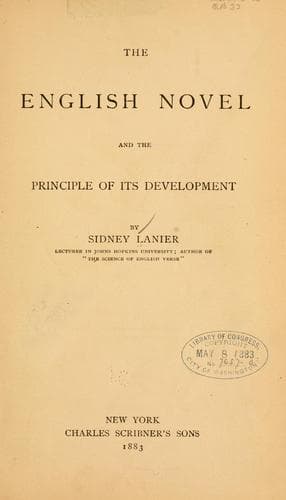
The English Novel and the Principle of its DevelopmentLanier, Sidney
History
The English Novel and the Principle of its Development
Lanier, Sidney
English fiction -- History and criticism
I sincerely wish it were in my power to develop, alongside of the
types of Maggie Tulliver and Aurora Leigh, a number of other female
figures which belong to the same period of life and literature. I
please myself with calling these the Victorian women. They would
include the name-giving queen, herself, the Eve in Mrs. Browning's
_Drama of Exile_, Princess Ida in Tennyson's _Princess_, Jane Eyre,
Charlotte Bronte, (one of these figures, you observe, is just as real
to us as the other; and I have lost all sense of difference between
actual and literary existence), Mrs. Browning, Dinah Morris, Milly
Barton, Janet Dempster, Florence Nightingale and Sister Dora, Romola,
Dorothea Brooke, Myra, Charlotte Cushman, Mary Somerville and some
others. If we are grateful to our sweet master Tennyson for his _Dream
of Fair Women_, how grateful should we be to an age which has given us
this realization of ideal women, of women who are so strong and so
beautiful, that they have subtly brought about--that I can find no
adjective so satisfactory for them as--"womanly" women. They have
redeemed the whole time. When I hear certain mournful people crying
out that this is a gross and material age, I reply that gross and
material are words that have no meaning as of the epoch of the
Victorian women. When the pessimists accuse the time of small aims and
over-selfishness, I plead the Victorian women. When the
pre-Raphaelites clamor that railroad and telegraph have fatally
scarred the whole face of the picturesque and the ideal among us, I
reply that on the other hand the Victorian women are more beautiful
than any product of times that they call picturesque and ideal.
And it is curiously fine that in some particulars the best expression
of the corresponding attitude which man has assumed toward the
Victorian women in the growth of the times has been poetically
formulated by a woman. In Mrs. Browning's _Drama of Exile_, during
those first insane moments when Eve is begging Adam to banish her for
her transgression, or to do some act of retributive justice upon her,
Adam continually comforts her and finally speaks these words:
... I am deepest in the guilt,
If last in the transgression.... If God
Who gave the right and joyance of the world
Both unto thee and me--gave thee to me,
The best gift last, the last sin was the worst,
Which sinned against more complement of gifts
And grace of giving. God! I render back
Strong benediction and perpetual praise
From mortal feeble lips (as incense smoke
Out of a little censer, may fill heaven),
That Thou, in striking my benumbed hands
And forcing them to drop all other boons
Of beauty and dominion and delight,--
Hast left this well-beloved Eve, this life
Within life, this best gift, between their palms,
In gracious compensation.
Public-domain text, read in full here on John Shaqi.
Reviews
Reviews
No reviews yet
Be the first to share your thoughts on this work.
Elsewhere in the archive
Join the Discussion
Join the discussion
Sign in to leave a comment or review.
Sign InorCreate an account